
Tinubu Directs Bishops to State Governors on Mission Schools
President Bola Ahmed Tinubu has declined a federal intervention on the long-standing demand for the return of mission schools, directing Catholic bishops instead to engage state governors, while pointing to expanded university approvals and student loan funding as evidence of progress in education access.
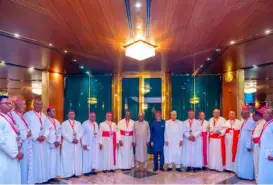
Receiving the leadership of the Catholic Bishops’ Conference of Nigeria (CBCN), led by its president, Most Rev. Matthew Ndagoso, Archbishop of Kaduna, at the State House, Tinubu responded directly to the bishops’ appeal for the return of schools originally established by Christian missions and later taken over by successive military governments in the 1970s.
“I returned all mission schools when I was the governor of Lagos State, and Cardinal Okogie, one of my best friends, is alive to testify to that,” the president said. He stressed that under the constitution the schools fall under state jurisdiction: “The schools are in the states. Preach to them, the governors of your states. They do the job. There is no need for a constitutional amendment for that.”
The CBCN delegation, which included Cardinals John Onaiyekan and Peter Okpaleke, Archbishop Alfred Martins of Lagos, Bishop Matthew Kukah of Sokoto and about 15 other senior prelates, had listed quality tertiary education and limited university spaces among their primary national concerns, alongside insecurity, poverty and the need for credible elections in 2027. They specifically urged the president to consider returning mission schools and ensuring fair treatment for places of worship.
Tinubu framed education as central to escaping poverty. “I believe in what you believe; we should embrace education to get out of poverty,” he told the bishops. He noted that additional universities had been approved to meet rising demand for higher education and said statistics from the National Universities Commission would guide budgeting for the Nigerian Education Loan Fund (NELFUND). He also cited the absence of prolonged Academic Staff Union of Universities (ASUU) strikes as a tangible improvement in the academic calendar.
The president presented NELFUND and related interventions as concrete steps to support families and keep students in school. He linked these measures to broader economic stabilisation, arguing that the country had moved beyond the financial uncertainties of earlier years and that prosperity was now “on the horizon.”
Mission schools have remained a persistent point of contention in Nigerian education policy for decades. Many were nationalised during military rule and placed under state control. While some governors have returned institutions to their original proprietors – Tinubu’s own Lagos administration between 1999 and 2007 being frequently cited as an early full restitution, others have retained them. The president’s remarks effectively closed the door on a federal constitutional route and placed the onus firmly on the 36 state governors.
In the same meeting Tinubu also addressed security restructuring and defended the neutrality of the Independent National Electoral Commission ahead of 2027, but education and the mission-schools question formed the most substantive policy exchange with the bishops. The CBCN leaders thanked him for recent engagement with the Holy See and reiterated their commitment to contributing to national development through education and healthcare.
The exchange leaves the practical future of the remaining government-held mission schools in the hands of individual state governments, while the federal government continues to emphasise expanded tertiary capacity and student financing as its primary levers for improving educational opportunity.
