
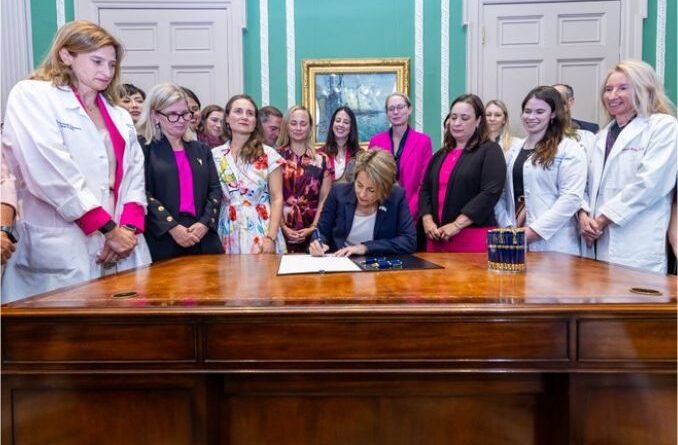
Massachusetts Governor Signs Expanded Abortion Law
Massachusetts Governor Maura Healey on Monday signed legislation that removes the state’s previous statutory restrictions on abortions performed at or after 24 weeks of pregnancy, leaving the decision solely to the professional judgment of the attending physician and placing Massachusetts among a small group of states with no gestational limit in law.
The measure, formally titled “An Act prioritizing patient access to care” and designated H.5595, was signed during a ceremonial event at the State House attended by lawmakers, physicians, reproductive rights advocates and patients. It takes effect in 90 days and amends Section 12N of Chapter 112 of the Massachusetts General Laws.
Under the prior framework, abortions at or beyond 24 weeks were permitted only when a physician determined the procedure was necessary to preserve the patient’s life or physical or mental health, or when it was warranted by a lethal fetal anomaly or a grave fetal diagnosis indicating the fetus could not survive outside the uterus without extraordinary medical intervention. The new language states simply that an abortion may be performed by a physician based upon the professional judgment of the physician, while a companion provision bars any medical review process from overriding the judgment of the treating physician and the patient or the patient’s health care proxy.
Healey presented the change as a direct response to families who had faced devastating late-pregnancy diagnoses or complications and been forced to travel out of state for care, often at considerable financial and emotional cost. “We’ve heard so many stories, stories that are filled with a lot of pain and anguish and heartache,” she said at the signing ceremony. “We’re signing this law so that new patients, people we won’t know or won’t meet, will be able to get the care that they need in Massachusetts.” She added that the state would continue to protect access no matter what actions might be taken by Donald Trump, Republicans in Congress or the Supreme Court, and that abortion would remain safe, legal and accessible in Massachusetts.
Advocacy groups including Reproductive Equity Now estimated that dozens of Massachusetts patients had been traveling out of state each year for post-24-week care under the previous rules. One couple who spoke at the ceremony, Kate Dineen and Alex Lawton, described traveling hundreds of miles to Maryland after receiving a catastrophic fetal stroke diagnosis at 33 weeks because their situation did not meet the prior exceptions.
With the signing, Massachusetts joins approximately nine other states – Alaska, Colorado, Maryland, Michigan, Minnesota, New Jersey, New Mexico, Oregon and Vermont, plus the District of Columbia in having no statutory gestational limit on abortion. State data show that 99 abortions at 24 weeks or later were reported in Massachusetts in 2024, up from 84 the previous year, out of a total of 49,450 induced terminations.
Pro-life organizations strongly condemned the change. National Right to Life President Carol Tobias said the law erased the final protections for unborn children who can feel pain and noted that at the stage when premature babies receive lifesaving care in neonatal intensive care units, Massachusetts will now permit the ending of pregnancies of the same age or later.
Massachusetts Citizens for Life President Myrna Maloney Flynn argued that the measure effectively authorizes abortions up to birth for any reason determined by the physician, including on healthy mothers and healthy fetuses, while also removing certain hospital-setting requirements.
The signing occurs as Healey campaigns for reelection in November.
