
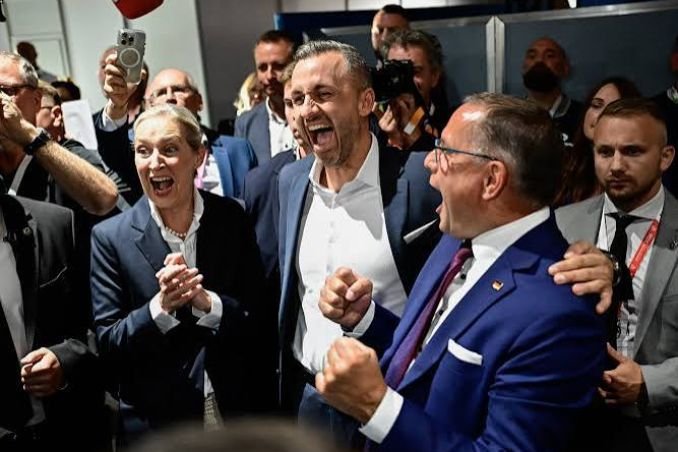
AfD Wins Saxony-Anhalt, Lacks Majority
Alternative for Germany finished first on Sunday in Saxony-Anhalt with 43.8 percent of the vote and 39 of 83 seats, the closest any party of its kind has come to running a German state since 1945, and still three seats short of the 42 it needed to govern alone.
The contest was for one of sixteen state parliaments, not the chancellery: schools, police and a large share of local economic life in a poor eastern region of about 2.1 million people. Ulrich Siegmund, the AfD’s 35-year-old lead candidate, told foreign media the public had made plain that it wanted change and wanted it with his party. Alice Weidel, a national co-leader, said Germans were “fed up with policy being made against Germany’s interests” and that the AfD had stood “to represent the interests of our country – not Ukraine’s, not any other country’s.” Donald Trump posted an exit-poll graphic; Kirill Dmitriev, a close associate of Vladimir Putin, amplified it. Weidel later said she expected Chancellor Friedrich Merz to be removed and a federal election “before Christmas.”
Those federal questions are not decided in Magdeburg. What the state can decide is culture, schools and policing, and that is where informed observers like Grégoire Roos of Chatham House expect an AfD-led administration, if one is formed, to push. The party campaigned on remigration – sending people without a German right to remain out of the country, on warmer relations with Russia, on traditional curricula and on an overhaul of public broadcasting.
Saxony-Anhalt’s domestic intelligence service has classified the AfD’s state branch as a confirmed right-wing extremist organisation; the party calls that label a smear. Other parties treat the classification as reason enough to keep the Brandmauer, the firewall against sharing office with it. Weidel calls that refusal undemocratic.
Merz’s Christian Democrats, who had run the state since reunification in 1990, fell to 17.2 percent and 15 seats. Sven Schulze, premier only since January, said the public had sent a message that had to be recognised. Turnout was 77.8 percent, the highest in the state since 1990.
The Social Democrats, Greens and Left each took about 9 percent and eight seats; the Sahra Wagenknecht Alliance, a breakaway from the Left, crossed the 5 percent line with 5.3 percent and five seats; the Free Democrats left parliament at 2.6 percent.
No combination is clean. The AfD plus Wagenknecht’s party would hold 44 seats; so would every other party if she joined them instead. Siegmund has said the BSW is part of the problem and that voters should get what they voted for, which he reads as AfD government rather than a bargain with the left. Tino Chrupalla, Weidel’s co-chair, has spoken of extending a hand to all parties. A minority cabinet remains possible in theory and unattractive to Siegmund for now. If talks fail, the state can be sent back to the polls.
