
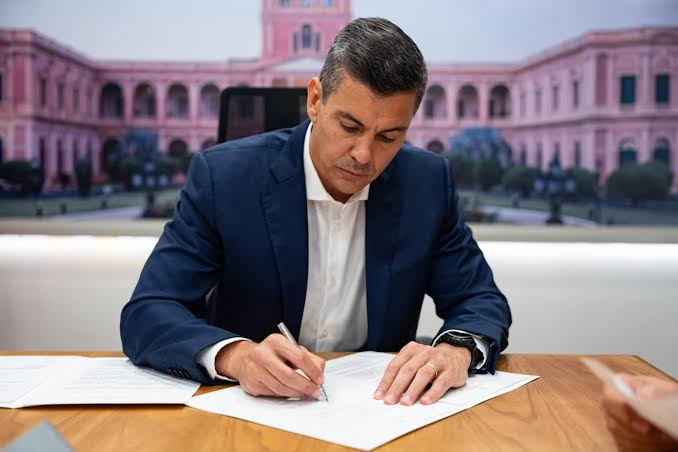
Paraguay’s Peña Under House Arrest After Ouster
Former President Santiago Peña was placed under house arrest Friday night, hours after Paraguay’s Senate voted unanimously to remove him from office over the collapse of Ueno Bank, whose seizure froze accounts for nearly three million people – roughly half the country’s population.
All 44 senators present convicted Peña of poor performance of his duties, stripping him of the lifetime Senate seat and parliamentary immunity that former presidents normally receive. One senator was absent.
Vice President Pedro Alliana was sworn in shortly afterward as president and will complete the term through August 2028. Prosecutors from the Economic Crimes and Anti-Corruption unit ordered Peña’s detention at his Asunción residence on suspicion of breach of trust and related offenses. The same order targeted former Central Bank President Carlos Carvallo, whom Peña had appointed.
Peña cooperated with police and remained at home under police watch without an electronic monitor for the time being. He is scheduled to appear at the prosecutor’s office Saturday morning. Attorney General Emiliano Rolón Fernández had already opened three criminal investigations examining regulatory oversight of the bank, the handling of its failure, and the placement of public funds.
The crisis began before dawn on Tuesday, November 3, when regulators seized Ueno Bank after a unanimous Central Bank board decision the previous day revealed that adjustments to its financial statements had dropped its solvency ratio below half the legal minimum.
Ueno, controlled by Grupo Vázquez, had grown rapidly since receiving a full banking license in 2023. It reported nearly three million customers, sponsored the national soccer team, and operated with a highly visible digital brand and cashback incentives. It held roughly $800–900 million in public-sector deposits – about a quarter of its total – including approximately $355–380 million from the Social Security Institute (IPS) pension and health fund, plus money linked to hydroelectric dams and other state entities.
Regulators and local reporting identified a pattern of risky, poorly documented lending to related parties of the controlling group that exceeded legal limits and lacked sufficient collateral. Once the books were corrected, capital was revealed as critically deficient.
A judge ordered six Ueno executives jailed pending trial, including founder Miguel Vázquez and bank President Juan Manuel Gustale, while prosecutors charged 27 bank officials and associates with breach of trust and attempted fraud. Raids and asset seizures followed. The Central Bank has described the failure as isolated and stressed that the broader system remains stable. A deposit guarantee fund covers up to roughly $36,000–$38,000 per depositor, which authorities say fully protects an estimated 97 percent of individual clients; advance payments to some depositors began Thursday.
Peña, 47, an economist trained at the Catholic University of Asunción and Columbia University, previously worked at Paraguay’s Central Bank and the IMF in Washington before serving as finance minister under Horacio Cartes from 2015 to 2017. He won the presidency in 2023 as the Colorado Party candidate and took office on August 15 of that year. He held a stake in Ueno’s holding company, which he divested in early 2025 under political pressure, and appointed Carvallo – a former Ueno executive, to head the Central Bank that supervised the lender.
On Thursday, November 5, as protests filled the streets of Asunción and the Colorado Party – including Cartes withdrew support, Peña announced his resignation in a video on X. He cited the need to preserve “the stability of our country, social peace and the need to preserve our democratic institutions,” apologized if he had failed the public, and insisted it was never his intention to betray trust. He offered to cooperate with investigators. Within minutes, the Chamber of Deputies voted 78 – 0 to impeach him. Congress rejected the resignation so that a formal removal would deny him senatorial immunity.
On Friday, Peña did not appear before the Senate despite earlier pledges to defend himself. His lawyers argued he had received the roughly 300-page accusation with insufficient time to prepare and reserved the right to challenge the process. Senators rejected a 72-hour delay and proceeded. The unanimous conviction marked only the second presidential removal by impeachment in Paraguay’s democratic era, after Fernando Lugo in 2012.
Alliana, 52, a Colorado Party veteran, former governor of Ñeembucú, and former Chamber of Deputies president, took the oath Friday evening. He promised that those affected by the “financial collapse” would be “fully compensated” and urged political sectors to prioritize depositors. An impeachment attempt against Alliana in the lower house had already failed. Protests continued in Asunción, with depositors, pensioners, and workers demanding access to savings and accountability. Some gathered outside Peña’s residence calling for jail rather than house arrest. Opposition figures, including Senator Yolanda Paredes, had publicly demanded pretrial detention.
Peña’s ouster ends a presidency that had been viewed as relatively stable in a region often marked by volatility. The speed of events – from bank seizure to resignation, impeachment, removal, succession, and house arrest in under four days has underscored both the concentration of public funds in a single private lender and questions about regulatory independence.
