
Trump Advances Syria Delisting to Ease Hormuz Bypass Route
President Donald Trump has notified Congress of his intention to remove Syria from the U.S. list of state sponsors of terrorism, a designation in place since 1979, as Washington explores alternatives to Iranian-controlled shipping lanes.
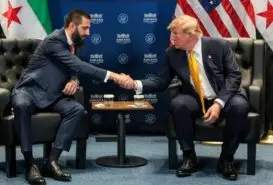
The announcement yesterday came hours after Iranian attacks on vessels in the Strait of Hormuz prompted Trump to annul a ceasefire. During a meeting with Syrian President Ahmed al-Sharaa on the sidelines of the NATO summit in Ankara, Turkey, Trump described al-Sharaa as “fantastic” and praised his efforts to stabilise the country. The two leaders were photographed shaking hands against American and Syrian flags.
Secretary of State Marco Rubio confirmed the formal notification to lawmakers, initiating a mandatory 45-day congressional review. Rubio called the step a historic opportunity for the Syrian people, citing governance reforms, counterterrorism actions, and assurances that Damascus will not support international terrorism.
The move builds on last year’s lifting of Caesar Act sanctions and signals deeper U.S. engagement with post-Assad Syria. Al-Sharaa, who once led Hayat Tahrir al-Sham after its roots in al-Qaeda’s Nusra Front and carried a $10 million U.S. bounty, headed the coalition that ousted Bashar al-Assad in 2024.
U.S. officials highlight al-Sharaa’s role in unifying factions, confronting Islamic State remnants, and establishing transitional authority. In a letter to the Syrian leader, Trump said American companies stood ready to invest and help rebuild the country.
Beyond sanctions relief, the delisting could position Syria as an alternative energy corridor, reducing reliance on the Strait of Hormuz. Syria’s Mediterranean coastline and proximity to Gulf producers offer potential pipeline and trucking routes to ports in Baniyas and Latakia for onward shipment to Europe and beyond.
Informed observers note that Iraq already trucks around 200,000 barrels of oil per day through Syria, though this remains modest compared with pre-war maritime volumes. Pipeline projects linking Saudi Arabia, Qatar, and other Gulf states to Syrian ports are under discussion. Syria holds proven oil reserves of roughly 2.5 billion barrels, with some estimates reaching 27 billion including offshore fields.
Chevron signed a deal in February with Syria’s state oil company for the country’s first offshore development, while Saudi and U.S. firms have formed a consortium for northeast exploration. A new commercial logistics hub at Tartus port, focused on Russian goods, is expected to open mid-July.
Mouayad Albonni of Karam Shaar Advisory described Syria as a geographic possibility for bypassing Hormuz risks but cautioned that challenges remain, including weak banking infrastructure, legacy sanctions complications, and security threats from residual terror groups. An Iraqi fuel tanker attack in northern Syria in early June underscored those risks. Russia also maintains a military and commercial presence at Tartus and Latakia.
Critics question whether al-Sharaa’s jihadist past and the transitional government’s record on minority rights justify rapid normalisation. Human rights groups continue monitoring developments. Democrats in Congress have broadly supported sanctions relief, lowering the chance of blocking the review.
If completed, the delisting would leave only Iran, North Korea, and Cuba on the U.S. terrorism sponsors list. It reflects Washington’s pragmatic recalibration in the Middle East amid ongoing Iran tensions, though success will depend on Syria’s ability to deliver stability and reliable transit routes.
