
Iran Freezes Indirect US Communications Over Israeli Military Operations in Lebanon
Iran has suspended indirect communications with the United States, citing Israeli military operations in Lebanon as a violation of the fragile ceasefire between Tehran and Washington.
The announcement, made through Iranian state-linked media, risks derailing diplomatic efforts to stabilise the region and has already triggered sharp rises in global oil prices.
Iran’s semi-official Tasnim news agency, which is close to the Revolutionary Guards, reported that Tehran’s negotiating team has stopped exchanging messages with Washington through mediators. Iranian officials insist the April ceasefire covers all fronts involving Iran and its allies, including Hezbollah operations in Lebanon and the situation in Gaza and that Israeli actions breach the agreement.
Foreign Minister Abbas Araghchi stated on X that “the ceasefire between Iran and the US is unequivocally a ceasefire on all fronts, including in Lebanon. Its violation on one front is a violation of the ceasefire on all fronts.” He demanded an immediate end to Israeli operations in Gaza and Lebanon, along with a full Israeli withdrawal from Lebanese territory.
According to Tasnim, Iran and the so-called “Resistance Front” (its network of allies in Lebanon, Yemen, and Iraq) have drawn up plans to block the Strait of Hormuz completely and activate other chokepoints, such as the Bab el-Mandeb Strait, in response to what they describe as aggression by Israel and its supporters.
Meanwhile, BRICS News reports that Lebanon is already calling for talks with Israel.
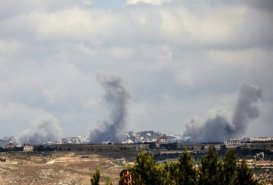
Prime Minister Benjamin Netanyahu and Defence Minister Israel Katz had ordered the IDF to hit sites in Beirut’s southern suburbs (Dahiyeh) after what Israel called repeated ceasefire violations by Hezbollah, including rocket and drone attacks on northern Israeli communities and IDF troops. Israel also announced the capture of the strategic Beaufort Castle in southern Lebanon, a symbolically and militarily significant site.
The UN Security Council is scheduled to hold an emergency meeting on the situation. Meanwhile, landmark indirect talks between Israel and the Lebanese government aimed at a longer-term deal continue this week, though progress has been slow.
Consequently, 0il prices have jumped more than 5%, with Brent crude approaching $96 per barrel as traders feared potential disruptions to roughly one-fifth of global oil supplies passing through the Strait of Hormuz. Equity markets also dipped on heightened geopolitical risk.
The suspension marks a setback for ongoing mediated talks that had offered hope of a broader de-escalation, including possible nuclear understandings and sanctions relief.
Residents were seen fleeing Beirut’s southern suburbs after Israel’s announcement, while Israeli communities near the border remain under intermittent rocket fire.
