
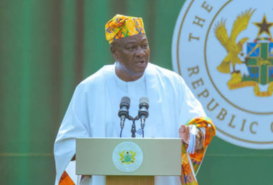
Ghana Backs Five-Year Presidential and Parliamentary Terms
Ghana’s government has formally accepted a key recommendation to extend the term of office for the president and members of Parliament from four years to five years, Attorney-General and Minister for Justice Dr Dominic Akuritinga Ayine announced on Thursday.
The decision forms part of the Executive’s comprehensive response to the final report of the Constitutional Review Committee, which President John Dramani Mahama established in early 2025. The eight-member panel, chaired by Professor H. Kwasi Prempeh, submitted its recommendations in December 2025 after reviewing Ghana’s 1992 Constitution.
Speaking at a Government Accountability Series briefing, Dr Ayine said the move was driven by practical governance considerations. “The government has accepted a recommendation to extend the term of office of the president from four years to five years, with the term of Parliament extended to correspond with this,” he stated. “Our thinking is practical. Under the current four-year cycle, the early months of every administration are consumed by transition matters, and the final year is largely consumed by elections. A five-year term provides a more realistic time frame for the formulation, implementation, and assessment of government policy.”
Officials clarified that the change, if approved, would apply only to future presidents and would not affect the current administration. The two-term limit on the presidency remains unchanged.
The government also accepted in principle a related proposal to lower the minimum age for presidential candidates from the current 40 years. However, it modified the threshold to 35 years rather than the 30 years recommended by the committee, citing the need to balance broader participation with the maturity required for the office.
Additional accepted measures include shifting presidential elections to a date in the first week of November, to be set by the Electoral Commission. This adjustment aims to create a clearer gap before the January 7 inauguration and improve the electoral calendar’s predictability. The government further endorsed stricter timelines for presidential election petitions: filing within 14 days of results declaration and Supreme Court determination within 30 days.
Dr Ayine explained that Cabinet had reviewed each recommendation thoroughly, categorising them as accepted, accepted in principle with modifications, or rejected. Other notable positions include capping Parliament at 300 members, with 24 seats reserved through proportional representation for women, persons with disabilities and youth, alongside various reforms on rights, institutional independence and decentralisation.
The path forward involves establishing a Constitution Review Implementation Committee to draft two amendment bills – one covering non-entrenched provisions and another for entrenched ones, expected by October 2026. Changes to entrenched provisions, including the presidential term length, will require a national referendum, tentatively planned alongside the 2027 District Assembly elections to minimise costs. For the referendum to succeed, at least 40 percent of registered voters must participate, with a minimum of 75 percent voting in favour.
Ghana has operated under the 1992 Constitution since the start of the Fourth Republic, maintaining relatively stable democratic transitions. Supporters of the five-year term argue it will enhance policy continuity and developmental focus. The government’s White Paper on the recommendations is expected to guide the next phase of consultations and legislative work. Implementation will ultimately depend on parliamentary approval and the outcome of the 2027 referendum.
