
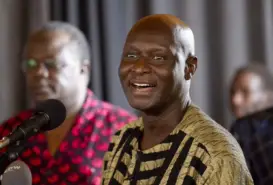
Uganda Nominates Veteran Diplomat Olara Otunnu as Seventh Contender for UN Secretary-General
In a late but significant entry into one of the most consequential leadership contests of the year, Uganda has formally nominated its veteran diplomat and former senior United Nations official Olara Otunnu as a candidate to succeed Secretary-General António Guterres.
The nomination, submitted on July 24 and circulated to all 193 member states the following day, elevates the field to seven contenders as the Security Council prepares to begin informal straw polls this week.
Otunnu, 75, becomes the oldest candidate in the race and the second from Africa after former Senegalese President Macky Sall. His nomination marks a striking political development in Uganda: the government of long-serving President Yoweri Museveni has put forward a man who once ran against him as the opposition Uganda People’s Congress candidate in the 2011 presidential election.
Born on September 6, 1950, in Mucwini in northern Uganda’s Acholi region, Otunnu brings more than four decades of high-level diplomatic experience. He served as Uganda’s Permanent Representative to the United Nations from 1980 to 1985 under President Milton Obote. In December 1981, while presiding over the Security Council, he introduced the informal straw-ballot system, still known as the “Otunnu Formula” – that has guided every subsequent selection of a secretary-general. He later chaired the UN Commission on Human Rights and served briefly as Uganda’s foreign minister in 1985-1986, playing a role in the Nairobi peace talks of that period.
From 1998 to 2005, under Secretary-General Kofi Annan, Otunnu held the post of Under-Secretary-General and the first Special Representative of the Secretary-General for Children and Armed Conflict. In that role he placed the protection of children in war firmly on the Security Council agenda, helped shape the monitoring and reporting mechanism under Resolution 1612 (2005), and advocated successfully for child-specific provisions in the Rome Statute of the International Criminal Court.
Uganda’s Ministry of Foreign Affairs described him as a distinguished statesman and international civil servant whose experience across the UN Secretariat, Security Council, national government, academia and civil society makes him exceptionally well suited to lead the organisation at this critical juncture.
In a 12-page vision statement titled “Outline Agenda for the United Nations” that accompanied his nomination, Otunnu describes the organisation as standing at “one of the most consequential periods since it was founded.” He pledges to prioritise ending major conflicts – specifically citing Ukraine, Gaza, Sudan, the Democratic Republic of Congo and Iran – restore the UN’s moral authority, complete institutional reforms under the UN80 initiative, and establish a dedicated UN body to oversee artificial intelligence development, safety and societal impact. On climate, he calls for action that supports rather than undermines economic development in the Global South.
Otunnu joins a competitive field that already includes Rafael Grossi of Argentina (Director General of the International Atomic Energy Agency), former Chilean President Michelle Bachelet, Rebeca Grynspan of Costa Rica (Secretary-General of UNCTAD), María Fernanda Espinosa of Ecuador, Carolyn Rodrigues-Birkett of Guyana, and Macky Sall of Senegal. Four of the six earlier candidates are women, and five hail from the Latin American and Caribbean Group – reflecting the widespread diplomatic view that it is the region’s “turn” and growing support for the first female secretary-general.
The six candidates who had entered earlier participated in a public debate in the General Assembly Hall on July 23. Otunnu’s nomination came too late for him to take part.
The selection process now moves into its decisive phase. The 15-member Security Council is expected to begin closed-door, anonymous straw polls as early as July 30, gradually narrowing the field until one candidate commands at least nine votes without a veto from any of the five permanent members – China, France, Russia, the United Kingdom or the United States. The successful nominee will then be recommended to the General Assembly for formal appointment, with the new secretary-general scheduled to take office on January 1, 2027.
Diplomats caution that no clear frontrunner has yet emerged. The incoming leader will inherit an organisation under severe strain – facing budgetary pressures, calls for deep bureaucratic reform, and a series of unresolved conflicts that have tested the UN’s credibility. Whether Otunnu’s deep institutional knowledge, African perspective and focus on peacebuilding and emerging technologies can overcome the regional rotation preference and the desire for a woman leader remains the central question as the process intensifies this week.
Additional candidates may still enter the race before the Security Council finalises its recommendation.
