
US Sinks Tanker as Iran Hits Jordan
The United States struck five Iranian oil tankers on Tuesday and sank one in the Gulf of Oman, after which Iran fired ballistic missiles at a Jordanian air base used by American forces and said its Revolutionary Guard had attacked ten ships near the Strait of Hormuz, the sharpest widening of a six-month war in weeks.
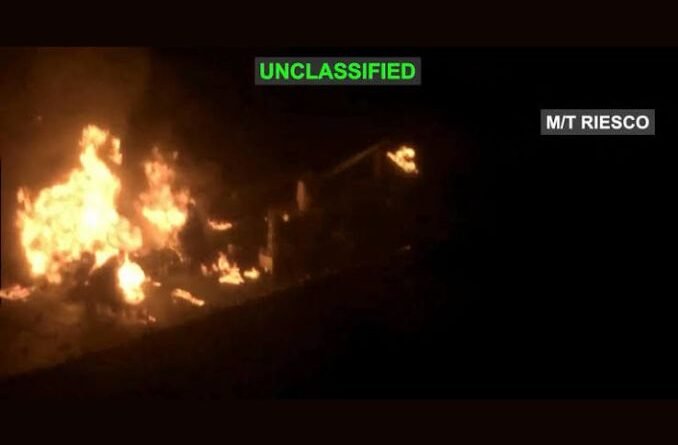
U.S. Central Command said four carriers were hit in the Gulf of Oman and a fifth near Kharg Island, Iran’s main oil-export hub. Video released by the command showed the M/T Riesco on fire and going down. Crews were told to abandon ship before the strikes; Iranian state media said sailors from two vessels reached shore in lifeboats.
Washington described the action as a reply to two Iranian ballistic-missile attempts against a U.S. Navy warship over the previous two days. The ship evaded both, CENTCOM said, and no Americans were hurt. Over the weekend U.S. forces had already hit three other Iranian crude carriers after what they called an attempt on an aircraft carrier and a destroyer. Secretary of State Marco Rubio, speaking in Barranquilla, Colombia, said that each time Iran tried to hit American naval ships, “they’re going to lose tankers.”
Iran answered on a different map. The Islamic Revolutionary Guard Corps said it had fired at Muwaffaq Salti Air Base near Azraq in Jordan. Amman said its air defences engaged twenty missiles, destroyed eighteen and saw two fall in empty ground, with no deaths. A U.S. official said the strikes were ineffective and that all American troops were accounted for.
Iran has hit Jordan before in this war, with at least two U.S. service members killed in a July attack. The IRGC also said on Wednesday that it had struck ten vessels – two American and eight tankers, trying to cross what it called a prohibited stretch of the strait. A maritime source reported damage to a liquefied-natural-gas tanker at Khor Fakkan in the United Arab Emirates, though responsibility was not established.
Meanwhile, state television carried an IRGC warning that tankers near Kuwaiti and Bahraini ports, which host U.S. forces, should leave immediately or be targeted. Hamidreza Azizi of the International Crisis Group called the Jordan barrage a geographic expansion and said firing on ships in Gulf ports, rather than only on vessels in the strait, would be a first.
Yemen’s Houthis, aligned with Tehran, opened another front on Tuesday. They said drones and missiles had hit a Saudi air base at Khamis Mushait and energy sites in Abha, Najran and Jazan. Riyadh reported fires and seventy-three wounded, including women and children. The attacks revived a war that had quieted after years of Saudi-led fighting in Yemen and added to a supply scare already lifting oil. Brent traded near one hundred dollars a barrel in early Wednesday dealing as tanker traffic through Hormuz stayed thin.
Washington layered economic measures on the same day. The Treasury has targeted twenty-seven Iranian airlines and nine service firms accused of supporting Mahan Air, sanctioned since 2011 over alleged work for the Guard. Foreign Minister Abbas Araghchi mocked the move on social media, asking whether “more sanctions” was the answer after war and earlier penalties had failed.
Separately, the Guard said it had trapped a U.S. uncrewed submarine at the mouth of the strait and identified it as an Anduril Dive-LD, a 5.8-metre autonomous vehicle used for survey, mine work and inspection of undersea cables. The Pentagon said an older drone had malfunctioned more than a day earlier while surveying regional waters and carried neither sensitive data nor classified sensors.
