
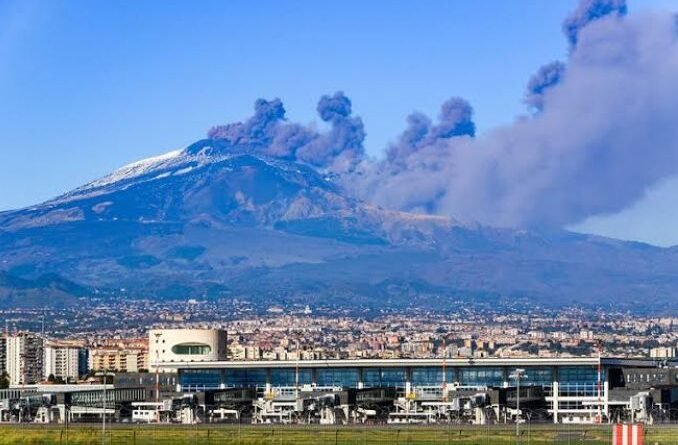
Mount Etna Ash Disrupts Catania Flights
Mount Etna’s latest eruptive phase continued to disrupt air travel on Monday as volcanic ash forced the temporary suspension of arrivals at Catania International Airport, extending a period of intermittent closures that has affected eastern Sicily since the weekend.
Airport operator SAC announced that arrivals would remain suspended until 17:00 local time on Monday after shifts in wind direction carried ash into additional airspace sectors over the Gulf of Catania. Passengers were advised to check the status of their flights directly with airlines before travelling to the airport, with further updates promised as conditions evolve. The disruption forms part of a pattern of repeated suspensions that began when activity intensified earlier in the week, leading to the closure of key corridors and the diversion of many inbound services to other Sicilian airports, particularly Palermo.
The current phase of activity centred on the Voragine summit crater developed rapidly from the evening of 6 August, producing powerful lava fountains overnight and into the following day before entering a sustained paroxysmal period on 8 August. A paroxysm describes a relatively short interval of heightened intensity involving vigorous lava fountaining, substantial ash emissions and rapidly changing eruptive conditions. Ash from the summit drifted southeast, producing fallout in nearby towns including Ragalna and Adrano.
At the same time, a new eruptive vent opened at approximately 2,750 metres, feeding a lava flow into the Valle del Leone. Italy’s National Institute of Geophysics and Volcanology reported additional activity in the Valle del Bove, with vents at varying altitudes continuing to supply lava and create extensive fields on the volcano’s flanks. Explosive activity at Voragine has fluctuated between intense ash emission and fountaining, keeping the aviation alert at red for extended periods and signalling ongoing hazards to aircraft.
Etna, Europe’s highest and most active volcano, erupts frequently, and its ash clouds have long presented a recurring challenge for Catania’s Fontanarossa airport, one of Italy’s busiest by passenger volume. The combination of summit explosions and flank flows in the present episode has produced a particularly persistent ash plume that has required repeated adjustments to airspace management. Departures of aircraft already on the ground have generally continued when conditions allowed, yet the overall effect has been significant delays, cancellations and diversions for travellers.
To mitigate the impact on stranded passengers, Trenitalia introduced additional rail services linking Catania with Palermo, including a direct train from Palermo airport station and further connections via Messina. These measures have provided alternative capacity while air operations remain constrained by the evolving volcanic conditions.
Monitoring by the National Institute of Geophysics and Volcanology continues around the clock, with seismic tremor remaining elevated even as intensity varies. The institute’s Volcano Observatory Notice for Aviation has stayed at the highest level during the more intense phases, reflecting the risk posed by ash in the atmosphere. Officials emphasise that the situation is under constant review and that decisions on reopening sectors will depend on both the volcano’s behaviour and prevailing winds.
