
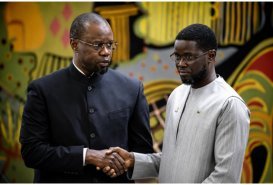
Senegal Regime Splits: Faye Ousts Prime Minister Sonko to Seize Total Executive Control
President Bassirou Diomaye Faye has dismissed Prime Minister Ousmane Sonko and dissolved the entire government in a surprise late-night move that ends the once-celebrated political partnership that led Senegal’s 2024 democratic transition.
In a decree read on state television by presidential secretary-general Oumar Samba Ba on Friday evening, May 22, 2026, President Faye terminated Sonko’s functions as Prime Minister and, by extension, those of all ministers and secretaries of state. The outgoing cabinet will continue handling day-to-day affairs until a new government is formed. No successor to Sonko had been named as of Saturday morning, May 23.
The decision marks the end of a high-profile alliance between the two men who rose to power together under the PASTEF party banner. Faye, a former tax inspector, won the March 2024 presidential election in a landslide after his mentor Sonko was barred from running due to legal challenges. Upon taking office in April 2024, Faye appointed Sonko as Prime Minister, creating what many analysts described as a “diarchy” that combined reformist energy with populist appeal.
Tensions between the two leaders had been building for months over economic policy, governance style, and control of the ruling PASTEF party. Senegal is grappling with a heavy debt burden – public debt stands at approximately 132% of GDP – and ongoing negotiations with the International Monetary Fund have been difficult. Sonko’s strong anti-establishment stance and skepticism toward certain international financial conditions reportedly clashed with Faye’s more pragmatic approach to reforms, especially regarding new oil and gas projects.
Disputes also emerged over leadership of PASTEF and the direction of the ruling coalition. Sonko retained significant personal popularity, particularly among youth and urban voters, and was increasingly seen by some insiders as overshadowing the president. Faye had publicly warned earlier in 2026 that the party risked collapse if internal divisions were not resolved. Sonko, for his part, had hinted that PASTEF might return to opposition if the government strayed from its original vision.
With legislative elections approaching and the 2029 presidential race already looming, both men appeared to be positioning themselves for the long term. Reports suggest Faye’s inner circle had been preparing for a post-Sonko government since at least April 2026.
Sonko has responded calmly to his dismissal. In a brief post on X, he wrote in French and Wolof: “Alhamdoulillah. Ce soir je dormirai le cœur léger à la cité Keur Gorgui” (“Praise be to God. Tonight I will sleep with a light heart in the Keur Gorgui neighborhood”). Supporters gathered outside his Dakar residence, but the atmosphere remained relatively calm rather than volatile.
The rupture introduces fresh uncertainty into one of West Africa’s most stable democracies. Senegal had been widely praised for its peaceful 2024 power transition at a time when several Sahel nations have experienced coups and instability. The country now faces the immediate challenge of forming a new government capable of addressing pressing issues: finalising an IMF deal, managing debt servicing, harnessing hydrocarbon revenues responsibly, and delivering on promises of economic sovereignty and social justice.
