
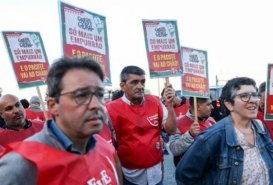
Portugal Hit by Second General Strike in Six Months Over Controversial Labour Reforms
Portugal faced widespread disruptions on Wednesday as the country’s largest trade union federation, CGTP-IN, led a 24-hour nationwide general strike against the centre-right government’s proposed “Trabalho XXI” labour reforms.
This marks the second such action in six months, underscoring deep divisions over the balance between economic modernisation and workers’ rights.
The strike brought significant parts of the country to a standstill. Long-distance and regional trains were largely halted, metro services in Lisbon and Porto were suspended or severely restricted, schools closed nationwide, non-urgent medical procedures were postponed, and hundreds of flights were cancelled at major airports including Lisbon, Porto and Faro. TAP Air Portugal operated only a fraction of its services under minimum requirements, with knock-on effects for international routes. Buses, ferries and many public services also ran at reduced capacity.
Prime Minister Luís Montenegro’s minority Democratic Alliance government argues that Portugal’s labour code is overly rigid, ranking the country near the bottom of OECD nations in labour market flexibility. The “Trabalho XXI” package contains more than 100 measures aimed at increasing working-hour flexibility through “time banks,” easing outsourcing and subcontracting rules, simplifying certain dismissal processes, and adjusting collective bargaining and strike rights. The government says these changes are essential to boost productivity, attract investment and lift annual economic growth from the recent 1.5-2% range toward 3.5-4%.
However, unions strongly disagree. CGTP-IN Secretary-General Tiago Oliveira described the reforms as a “package made to measure for big companies” that would entrench precarious employment, deregulate working schedules, weaken collective bargaining and erode protections for workers and families. A 30-year-old bank employee, Rodrigo Azevedo, told Reuters the changes would leave young workers “stuck on precarious contracts for life,” forcing them to work up to 50 hours a week without extra pay.
This is the second general strike called against the same reform package. A previous action in December 2025 failed to halt its parliamentary progress, and the bill is now expected to advance with support from the far-right Chega party. The UGT, Portugal’s other major union confederation, did not fully back today’s strike, though some of its affiliates participated.
Labour Minister Maria do Rosário Ramalho said private sector participation (the main target of the reforms) was marginal, insisting “the overwhelming majority of workers are working and the economy has not stopped.”
The timing is politically sensitive for Montenegro’s minority government. While the reforms are presented as necessary modernisation, critics see them as an attack on hard-won social rights at a time when many Portuguese are struggling with rising costs of energy, food, rents and fuel.
Union leaders have vowed to continue resistance unless the bill is withdrawn or substantially revised, even as parliament is expected to debate the legislation further in the coming weeks.
For travellers, residual disruptions may continue into Thursday. Passengers facing cancellations or significant delays may be entitled to compensation under EU rules, up to €600 depending on the circumstances.
