
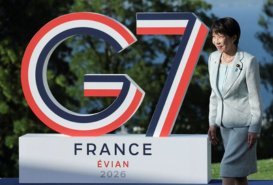
PM Takaichi Proposes G7 Critical Minerals Stockpiling Plan at Debut Summit
Japanese Prime Minister Sanae Takaichi used her debut appearance at the Group of Seven leaders’ summit to propose a coordinated international framework for stockpiling critical minerals, drawing directly on vulnerabilities exposed by the recent closure of the Strait of Hormuz amid tensions between the United States and Iran.
Takaichi presented the “Joint Stockpiling Cooperation Initiative” during a working dinner on June 15, 2026, focused on global supply chain resilience and major international challenges. The proposal aims to strengthen collective preparedness among G7 members and like-minded partners against disruptions in supplies of rare earths and other essential minerals critical to electric vehicles, semiconductors, defense technologies, and renewable energy.
Japan, the only G7 country with an established national stockpiling system managed by the Japan Organization for Metals and Energy Security (JOGMEC), is positioning itself to lead the effort. Key elements of the initiative include encouraging participating countries to establish or expand national stockpiles covering at least 90 days of supply, coordinating joint releases during crises in tandem with the International Energy Agency (IEA), and limiting access to companies actively diversifying away from high-risk suppliers. It also envisions shared procurement to develop alternative sources and mutual reserve-sharing arrangements.
The proposal builds on previous G7 commitments, including action plans from Japan’s 2023 presidency, and is expected to be reflected in the summit’s final outcome document. Informed observers anticipate it could lead to the creation of a dedicated working group with the IEA.
Takaichi’s initiative comes against the backdrop of China’s dominant position in global mineral supply chains. Beijing controls roughly 60 percent of rare earth extraction and up to 90 percent of processing capacity worldwide. This concentration has raised concerns about potential economic coercion through export restrictions, as seen in past disputes.
The Japanese leader explicitly linked her proposal to the recent disruptions in the Strait of Hormuz, a vital chokepoint through which about one-fifth of global oil passes. Japan, which has historically imported up to 90 percent of its crude oil from the Middle East, was among the countries most affected when navigation was restricted. Takaichi welcomed the US-Iran memorandum of understanding as a “major step toward de-escalation” and stressed the importance of ensuring safe passage for stranded vessels and crews.
Takaichi further outlined three core principles for energy security: firm opposition to unjustified export restrictions, enhanced support for oil stockpiling in Asia with closer IEA coordination, and stronger producer-consumer dialogue to deter coercive practices. These align with Japan’s existing POWERR Asia initiative.
Takaichi’s emphasis on resilience reflects Japan’s strategic priorities as a resource-poor but technologically advanced economy. The country has been steadily building partnerships to diversify supply chains, including rare earth collaborations with France and Australia, and support for mineral development in resource-rich nations through multilateral development banks.
This G7 summit marks Takaichi’s first major international gathering since taking office. On her way to France, she held bilateral meetings in the United Kingdom and Italy, where she advanced economic security cooperation. In London, she issued a joint declaration with UK Prime Minister Keir Starmer on critical minerals and supply chains.
Beyond minerals and energy, Takaichi reiterated Japan’s commitment to the “Free and Open Indo-Pacific” strategy and expressed concerns over North Korea’s nuclear and missile programs. On Iran, she called for continued coordination with the International Atomic Energy Agency (IAEA) to ensure Tehran does not develop nuclear weapons, referencing Japan’s unique perspective as the only country to have suffered atomic bombings.
Observers describe Takaichi’s approach as pragmatic and assertive, often characterized as that of an “Iron Lady” focused on reinforcing the rules-based international order amid great-power competition and occasional divergences between the United States and Europe.
The three-day summit, hosted by French President Emmanuel Macron, is expected to produce joint statements on supply chain diversification, economic security, and stability in the Middle East. Implementation of the stockpiling initiative would likely involve expert exchanges from JOGMEC and joint investments in alternative mining and processing capacity.
For Japan, the Hormuz crisis served as a stark reminder of supply chain fragility. By championing collective stockpiling and diversification, Takaichi is seeking to transform national vulnerability into a catalyst for broader G7 cooperation. The proposals come at a time when global economies continue to grapple with fragmented supply chains and geopolitical uncertainties.
