
NATO Launches Drone Edge Initiative at Ankara Summit
NATO allies have announced the “Drone Edge” initiative at the alliance’s summit in Ankara, committing $40 billion over the next five years to expand drone operations and strengthen defences against unmanned aerial threats.
Unveiled today, the initiative aims to enhance the alliance’s ability to deploy and operate drones at scale while investing heavily in counter-drone capabilities and operator training.
According to details released with the announcement, member states plan to train five times more drone operators by the end of 2027 and establish a NATO-compatible procurement marketplace for interoperable systems.
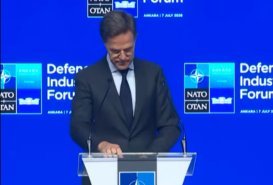
NATO Secretary General Mark Rutte highlighted drones as a central focus of both leaders’ meetings and the accompanying Defence Industry Forum. “From defence plans to drones, from money to missiles and interceptors,” he said, stressing the need for rapid innovation in a “dangerous world.”
The initiative draws lessons from Russia’s war in Ukraine, where low-cost drones have challenged even advanced air defences. Recent incidents of Russian drones straying into NATO territory, including one striking an apartment in Romania, have added urgency.
Traditional responses using fighter jets against inexpensive drones have proven prohibitively expensive, prompting a shift toward layered counter-UAS solutions including electronic warfare, kinetic interceptors, and AI-enhanced detection.
Drone Edge combines offensive drone capabilities with robust defensive measures. It builds on NATO-EU cooperation, including joint centres of excellence and shared standards. Parallel European Union investments, such as €200 million through the European Defence Fund, signal close transatlantic alignment to avoid duplication.
Türkiye, as summit host, plays a prominent role. A leading global producer of UAVs, the country brings operational expertise, including the amphibious assault ship Anadolu as a floating drone base and industrial capacity. Events such as NATO EDGE-26 in İzmir further highlight Ankara’s contribution to the alliance’s technological transformation.
Informed observers see the initiative as part of NATO’s broader pivot toward innovation and deterrence. With allies increasing defence spending toward ambitious targets, Drone Edge seeks to convert financial pledges into interoperable systems, rapid training pipelines, and resilient supply chains. Challenges include scaling production and ensuring cohesion across 32 members, but officials stress the programme complements rather than replaces manned aviation and missile defences.
NATO describes the effort as essential for achieving dominance through smarter, connected, and more economical systems in an era of drone-dominated warfare.
