
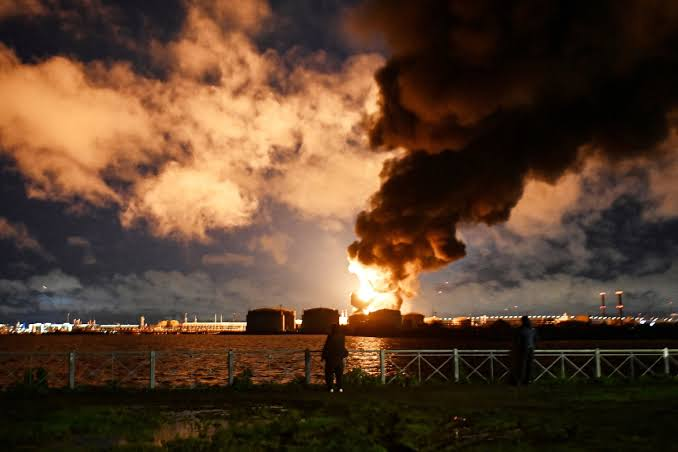
Ukraine Strikes St Petersburg Oil Terminal
Ukraine launched one of its largest drone attacks of the year on Russia overnight on Saturday, hitting the St Petersburg Oil Terminal despite a demand from US President Donald Trump that Kyiv stop targeting Russian energy infrastructure.
Trump responded on Sunday by accusing President Volodymyr Zelensky of not wanting to end the war, widening a rift that has alarmed Kyiv as it heads into another winter of Russian bombardment.
Russia’s defence ministry said it shot down 1,015 Ukrainian drones overnight into Sunday across various parts of the country. Russian authorities named the St Petersburg Oil Terminal, which can handle up to 12.5 million tonnes a year, as one target. Fire Point, the Ukrainian company that makes the drones used in the attack, said a fire broke out on the terminal’s grounds. A logistics centre in the city was also hit, according to the distributor Ozon, as was a data centre for the social network VKontakte. Local authorities reported one person killed and five wounded, with residential buildings damaged.
Trump, writing on Truth Social, said he is negotiating peace and does not want to do anything that would “foolishly” drive Russia from the bargaining table, adding that he believes “great progress is being made.” He said Zelensky “doesn’t want to end this war, and probably never did.” Zelensky said he spoke with US envoy Steve Witkoff and Trump’s son-in-law Jared Kushner on Sunday as part of “nonstop communication” aimed at peace, writing on X that Ukraine was doing everything on its side to ensure America’s position was strong.
The strike came a week after Trump said Russia and Ukraine had agreed to stop attacking each other’s energy infrastructure, a claim Zelensky initially answered with “News to me,” according to Times of Israel coverage at the time. CNN reported that neither Kyiv nor Moscow acknowledged any such agreement. Ukraine briefly halted its attacks before resuming them, while Russia never stopped hitting Ukrainian energy plants and cities. Zelensky said on Sunday that Russia had attacked Ukraine’s energy and oil and gas sectors 76 times since the US president announced the ceasefire. Ukrainian authorities said Russian missile and drone attacks killed 11 people and injured nearly 50 across the country in the 24 hours to Sunday morning, including a large attack on energy facilities in the Odesa region.
Tension with Washington extends beyond the strikes. Trump has waived sanctions on imports of Russian diesel and, on Friday, invoked a waiver exempting Russia from sweeping economic penalties mandated by Congress, drawing criticism that included some Republicans. Zelensky told NBC News’ “Meet the Press” that the US siding with Russia would be a “historic mistake” and that the waiver amounted to “more support for Russian aggression” while Moscow was failing on the battlefield. He also said Ukraine’s access to the Starlink satellite system for guiding battlefield drones remained curtailed, calling it “a message from the American government” to limit the speed at which the drones could fly. The Trump administration has denied ordering the service restricted. Zelensky further said the US had blocked intelligence sharing for three days during ballistic missile attacks, though it has since been restored. A Ukrainian source told CNN there was no early warning before a ballistic missile attack on Kyiv on Sunday, the third such instance in a week.
Asked about Trump’s remark that he is harder to deal with than Russian President Vladimir Putin, Zelensky said it was “better to have partners who are very open and clear than to have those who are killers, even with a smile on their face.” He said he wanted to trust Trump and hoped he would change his attitude toward Putin. Asked whether Trump is an ally of Ukraine, he replied: “I hope so.”
The strikes come as UN monitors report civilian harm at record levels. The UN human rights monitoring mission said at least 328 civilians were killed and 2,105 injured in Ukraine in September, 85 per cent more than in September 2025, with casualties recorded in 22 regions and in Kyiv, where civilians were hurt on 22 of the month’s 30 days, more often than in any month since the full-scale invasion began. The trend has continued into October. A Russian cruise missile and drone attack on the night of 6 to 7 October killed 22 civilians and injured 45 in Pryluky, in the Chernihiv region. “The first two weeks of October were among the deadliest periods for civilians in years,” said Danielle Bell, head of the mission.
Energy infrastructure is again a central target. On 13 and 14 October, strikes hit multiple energy facilities, including Kyiv’s three main power stations, which temporarily left 600,000 people in the capital without electricity, according to Ukrainian authorities. The mission also noted that Ukrainian forces have targeted electricity and heating infrastructure in occupied territory and inside Russia. Bell warned that systematic attacks on such infrastructure as winter nears are bound to cause significant suffering for civilians.
The International Organization for Migration (IOM) warned that damaged homes and attacks on energy supplies could force returnees to flee again. About 1.45 million returnees now live in frontline districts, and only 32 per cent of households could heat their homes adequately during the last cold season. About 2.1 million older people live alone in apartment buildings, leaving them especially exposed to prolonged outages. IOM’s Regional Director for Europe and Central Asia, Arthur Erken, said the question for millions of Ukrainians is whether they can remain at home safely, and noted that less than seven per cent of IOM’s crisis response plan for Ukraine this year is funded.
At the Zaporizhzhia nuclear power plant, the eighth localised ceasefire brokered by the International Atomic Energy Agency began on Thursday to allow repairs to a damaged backup transformer that would strengthen the plant’s link to its only remaining external power line. IAEA Director General Rafael Mariano Grossi welcomed both sides’ cooperation but warned that diesel fuel at the plant is running low, with no deliveries since March, and urged that supplies be increased before winter.
