
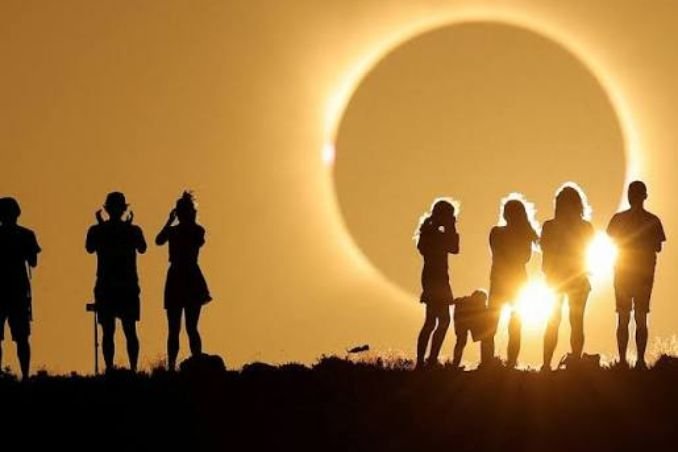
Europe Witnesses Rare Total Eclipse
Millions of people across Europe and the Arctic watched day turn briefly to night on Wednesday as the Moon completely obscured the Sun, delivering the continent’s first total solar eclipse since 1999.
The path of totality, a narrow corridor roughly 180 to 300 kilometres wide, began over northern Siberia and swept southward through eastern Greenland and western Iceland in the late afternoon before crossing the North Atlantic and making landfall in northwestern Spain near A Coruña around 8:27 p.m. local time. The shadow then tracked east-southeast across Spain, covering locations including León, Burgos, Zaragoza, Valencia and parts of the Balearic Islands, including Mallorca, before ending over the Mediterranean at sunset. A small corner of northeastern Portugal also experienced totality.
Maximum duration reached 2 minutes and 18 seconds over the Denmark Strait west of Iceland. In Reykjavík, totality lasted about one minute beginning at 5:48 p.m. local time. In Spain, durations ranged from roughly one to nearly two minutes, with the Sun low on the western horizon producing a striking sunset eclipse effect.
A partial eclipse was visible across a far wider area of the Northern Hemisphere. Much of Europe, including the United Kingdom, France, Germany and Italy, saw deep partial phases in the evening, often with the crescent Sun setting while still eclipsed. Northwestern Africa and parts of northern and eastern North America also experienced partial coverage.
Crowds gathered at official viewing sites, hilltops, beaches and rooftops. In Spain, where mainland total eclipses had not occurred since 1905, authorities deployed tens of thousands of police and civil guard personnel, distributed millions of certified eclipse glasses and designated hundreds of official viewing areas. Estimates suggested as many as six million people would enter the path of totality, generating substantial economic activity. Hotels along the route had been booked months in advance.
Spectators in northern Spanish towns chanted as the Moon took its first bite of the Sun. When totality arrived, the solar corona appeared as a silvery halo, prompting applause and emotional reactions. Similar scenes unfolded in Iceland, where the last total eclipse visible from Reykjavík occurred centuries earlier. Birds called as if dusk had fallen, temperatures dropped noticeably, and viewers described the sudden darkness as both eerie and beautiful. Clouds, rain or wildfire smoke obscured the view in some locations, though many still caught the critical moments during brief clearings.
The eclipse belonged to Saros series 126. Greatest eclipse occurred at approximately 17:46 UTC near 65°N, 25°W. Occurring near lunar perigee, the Moon appeared large enough to fully cover the solar disk. The high-latitude path kept the Sun relatively low, offering photographers dramatic compositions. Animal behaviour shifted as expected during totality, with birds falling silent or returning to roosts.
For those outside the narrow band of totality, the partial phases still produced memorable sights of a progressively bitten solar disk low in the western sky. Officials repeatedly stressed the need for proper eye protection except during the brief moments of totality itself.
The event marked a rare shared experience across a wide swath of the Northern Hemisphere. While total solar eclipses occur somewhere on Earth roughly every 18 months, any given location may wait centuries between them. For mainland Europe the interval since 1999 had stretched nearly 27 years; for much of Spain it had been more than a century. Wednesday’s alignment offered a fleeting demonstration of celestial mechanics and a moment of collective wonder.
