
Roman Telescope Leaves Earth for Lagrange Point
NASA sent its newest flagship observatory into space on Sunday morning, placing the Nancy Grace Roman Space Telescope on a three-month path toward the Sun-Earth Lagrange Point 2, from which it is meant to survey dark energy, dark matter and planets that ordinary telescopes cannot easily see.
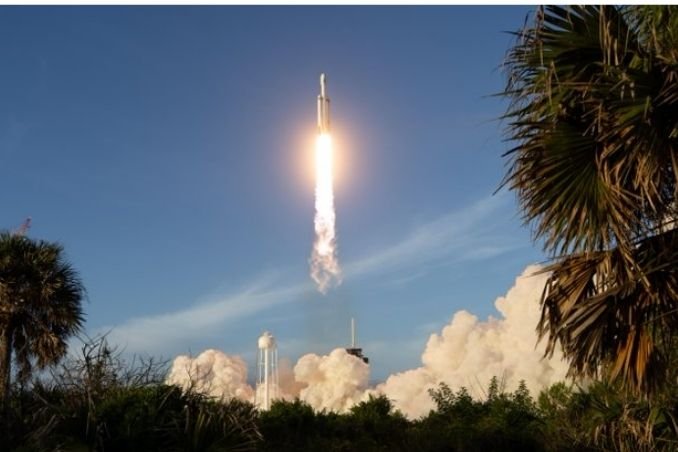
The Falcon Heavy left Launch Complex 39A at Kennedy Space Center at 7:26 a.m. EDT. Twenty-seven engines produced more than five million pounds of thrust, the side boosters flew home to Cape Canaveral, and the center core was spent. Thirty-one minutes after liftoff the observatory separated from the upper stage. Goddard picked up the first telemetry seven minutes into the flight; solar arrays and the lower sunshade opened a little more than an hour later, and the Deep Space Network took over communications about seventy minutes after the rocket left the pad.
The $4.3 billion mission flew nearly nine months earlier than the official May 2027 readiness date and within its budget, a point Administrator Jared Isaacman underlined when he praised the workforce and industry partners who finished construction and testing ahead of plan. The telescope carries the name of Nancy Grace Roman, NASA’s first chief of astronomy and a principal advocate for Hubble. Its 2.4-metre mirror matches Hubble’s aperture, but the Wide Field Instrument behind it can photograph a patch of sky at least a hundred times larger in a single exposure. A coronagraph from the Jet Propulsion Laboratory will try to suppress starlight well enough to image giant planets around other stars.
Once it reaches a halo orbit around L2 – the same quiet region already occupied by the James Webb Space Telescope, Roman is expected to chart the growth of structure through weak gravitational lensing, measure cosmic expansion with supernovae and large-scale surveys, and find exoplanets when their gravity briefly magnifies background stars. Planners speak of on the order of 100,000 new worlds during a five-year prime mission and of a public archive that will run to tens of thousands of terabytes. The data are meant to be released soon after processing, so that Hubble, Webb, Euclid and the Vera C. Rubin Observatory can follow up on what the wide-field camera first notices.
NASA intends to publish the first science images in early 2027. The spacecraft will downlink about 1.4 terabytes a day, a volume that will depend on automated tools and outside researchers as much as on the instrument itself. More than 1.3 million names travel on a memory card attached to the observatory.
