
France Reels After Violent Protests
French Prime Minister Sébastien Lecornu is holding a crisis cabinet meeting on Monday after a weekend of looting and street violence that followed nationwide cost-of-living protests, with the government under fire over its preparations and President Emmanuel Macron’s response. The BBC described the scenes as among the worst public disorder in modern French history.
The unrest began on Saturday 17 October, when authorities said about 550,000 people took part in demonstrations across the country against rising living costs and declining public services, including education. The CGT union put turnout at about 800,000. The protests followed weeks of student demonstrations over conditions in schools, and France 24 reported that the Yellow Vest movement had called the “yellow and youth” day of action. Most marchers were peaceful, but groups of masked, black-clad activists and vandals appeared during the day, and looting and arson spread to Paris, Marseille, Bordeaux, Nice, Strasbourg and other cities. Riot police used tear gas and water cannon and were seen striking people with batons in several places, according to the BBC.
The damage was extensive. The Retail and Trade Federation said around 1,500 businesses were damaged, with losses estimated in the hundreds of millions of dollars. Interior ministry figures reported by the BBC put the number of police officers injured at about 1,000, seven of them seriously, while France 24 reported Interior Minister Laurent Nuñez as saying around 500 police, firefighters and paramedics were hurt. A 17-year-old boy lost his right hand to a crowd-control grenade in Saint-Étienne, and prosecutors said a 17-year-old girl lost an eye in Mulhouse. One person died during the main march in Paris, though officials said the death was health-related.
Arrest totals vary by report, from about 1,800 to nearly 2,400 nationwide. In Paris, 550 of the 855 people arrested remained in custody on Sunday, and the Legal Team Paris group of lawyers said police stations were struggling to cope.
Disorder resumed on Sunday. Several hundred people gathered at the Place de la République in Paris after social media calls for a rally that authorities had not approved. The Paris police prefecture said officers moved in “faced with the initial signs of tension,” firing tear gas and stun grenades as bottles and rocks were thrown, and making several arrests. A clothing store was looted and bicycles were set alight nearby, and a clothing store was also looted in Lyon.
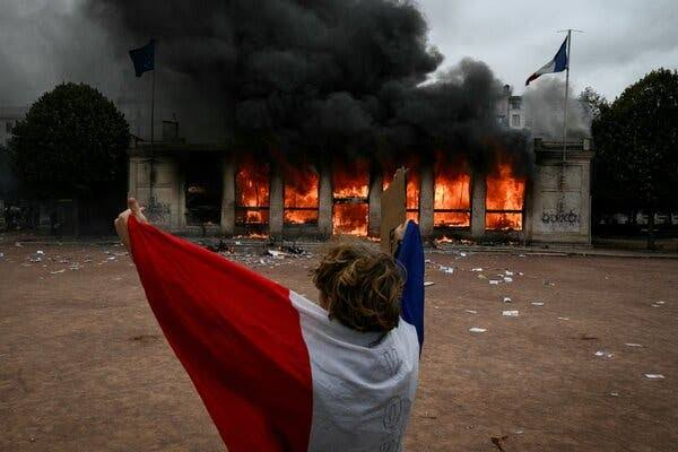
In Limoges, a 19th-century town hall was destroyed by a fire that local prefect Maurice Barate told LCI had been deliberately set by “a wild horde.” About 7,000 people marched in the city on Sunday in protest at the devastation. A tourist office in central Lyon was also set ablaze during Saturday’s clashes. Mehmet Ozeden, a 78-year-old Paris resident, told AFP: “It’s like we had a war.”
Macron addressed the nation on Sunday evening. “Tonight, we all feel anger and shame,” he said, insisting that “nothing justifies, nothing excuses” the violence, which he called unprecedented. He drew a distinction between protesters with legitimate demands and “those who destroyed, smashed, and looted,” and vowed the government would be uncompromising. “Those who have destroyed must pay,” he said. After days of speculation about a curfew or a state of emergency, he announced neither.
The speech drew criticism on social media and from political opponents for lacking detail on how perpetrators would be held to account, how businesses would be compensated, and when a dialogue with student and teacher organisations would begin. CGT general secretary Sophie Binet accused Macron of failing to address students’ concerns, the cost of living or the decline of public services.
The political blame game began quickly. Macron and Lecornu attributed the violence to radical far-left groups and delinquents. Far-left leader Jean-Luc Mélenchon accused the authorities of incompetence and of inflaming tensions. Marine Le Pen, the National Rally candidate who leads opinion polls ahead of the presidential election, said the government was “running on fumes, exhausted and disoriented” and spoke of a profound crisis of trust and authority that threatened democracy.
US President Donald Trump weighed in on social media, declaring “France is burning!” and blaming immigration for the unrest. Lecornu and Nuñez face accusations from many in France of having been ill-prepared and of under-policing the protests, and National Assembly president Yaël Braun-Pivet has said she wants a parliamentary inquiry into what happened and why.
There is little prospect of a lull. Students begin their half-term break on Monday, but trade unions and the Yellow Vest movement have announced large protests for 5 November. The unrest comes about six months before the presidential election, with parliament divided among three rival blocs and investors pressing the government to rein in public debt, a task the government fears could spark further anger if it involves cuts to services or welfare.
