
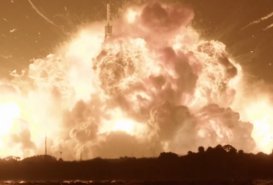
Blue Origin’s New Glenn Rocket Explodes in Dramatic Static Fire Test at Cape Canaveral
Blue Origin suffered a major setback on Thursday evening when its powerful New Glenn rocket exploded during a routine static fire test at Launch Complex 36 in Cape Canaveral, Florida.
The incident happened around 9 p.m. ET on May 28, 2026, lighting up the night sky with a massive fireball and sending a thick plume of smoke drifting over Florida’s Space Coast.
Witnesses miles away reported hearing the blast and feeling the ground shake. Thankfully, no one was injured, and the company quickly confirmed that all personnel had been safely accounted for.
In a brief statement posted on X, Blue Origin called the event an “anomaly” during the hotfire test and said an investigation was already underway. Founder Jeff Bezos responded personally, acknowledging the disappointment but adding a note of determination: the team would “rebuild whatever needs rebuilding.”
The fully stacked New Glenn – a towering 322-foot (98-meter) heavy-lift rocket – was undergoing a critical pre-launch engine test. Its first stage, powered by seven BE-4 engines burning liquid methane and liquid oxygen, was firing while anchored to the pad.
Video footage shows bright ignition flashes at the base, followed almost immediately by catastrophic structural failure and a powerful explosion that heavily damaged the launch infrastructure, including at least one lightning tower and parts of the transporter-erector system.
New Glenn was meant to be Blue Origin’s flagship orbital vehicle, designed to carry heavy payloads for both commercial customers and national security missions. The rocket that exploded was preparing for its NG-4 flight, which was expected to deploy satellites for Amazon’s Kuiper broadband constellation. That mission, along with several others in the queue, will now face substantial delays while the company investigates what went wrong and repairs the damaged pad.
This is not Blue Origin’s first challenge, as the company had only recently cleared an investigation into an upper-stage issue on the NG-3 mission in April. Despite these hurdles, New Glenn had shown promise, completing a successful maiden flight in January 2025 and achieving its first booster recovery later that year.
The financial hit is likely to be substantial – replacing the lost booster, repairing the launch complex, and absorbing the schedule delays could cost hundreds of millions of dollars. Still, the industry knows these kinds of tests exist precisely to uncover problems on the ground rather than in flight.
Elon Musk offered a brief but empathetic reaction on X: “Most unfortunate. Rockets are hard.” The comment captured a widely shared sentiment across the space community – that even the most experienced teams can face sudden and spectacular failures during development.
As the investigation begins, Blue Origin will be poring over telemetry data, video footage, and wreckage to understand exactly what caused the explosion. For now, the skies over Cape Canaveral are quieter than planned, but the drive to push the boundaries of spaceflight continues.
