
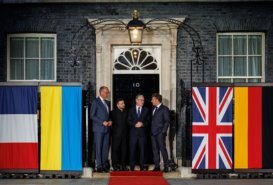
E3 Leaders Pledge Continued Support for Ukraine After Downing Street Talks With Zelenskyy
British Prime Minister Keir Starmer has described the United Kingdom’s backing for Ukraine as “ironclad,” saying Britain will stand with the country “for as long as it takes” and that “Ukraine’s security is Europe’s security.”
The statement, which closed with the Ukrainian phrase “Slava Ukraini,” followed a high-level summit at 10 Downing Street on June 7 involving Starmer, Ukrainian President Volodymyr Zelenskyy, French President Emmanuel Macron and German Chancellor Friedrich Merz.
The leaders met to discuss strengthening Ukraine’s defences and exploring diplomatic avenues as the conflict with Russia enters its fifth year. Zelenskyy later posted on X that he had briefed Starmer on Ukraine’s immediate needs, including additional missiles for air-defence systems and measures to protect the energy sector ahead of winter. He also said the group coordinated positions ahead of upcoming G7 and NATO summits.
A joint statement issued by the three European nations and Ukraine condemned Russia’s recent large-scale missile and drone attacks, including repeated use of the Oreshnik hypersonic system, which have caused civilian casualties in Ukrainian cities. The leaders welcomed Ukrainian battlefield gains, including territorial liberations and long-range drone strikes inside Russia, such as the recent operation near Saint Petersburg.
The E3 group explicitly endorsed Zelenskyy’s open letter to Russian President Vladimir Putin dated June 4. In that letter, Zelenskyy proposed an immediate ceasefire along the current line of contact, a direct face-to-face meeting in a neutral third country, and a complete “all-for-all” prisoner exchange, with monitoring by the United States and European partners.
The joint statement outlined five principles for any “just and lasting peace”: an immediate and full ceasefire; negotiations based on the existing frontline without forced territorial changes; robust, legally binding security guarantees for Ukraine, potentially including a multinational force; the use of immobilised Russian assets to fund reparations until aggression ends; and safeguards for wider European security that would require agreement within the EU and NATO.
The participants agreed to intensify military and economic pressure on Russia in the coming weeks, coordinating at the G7 summit in Evian, the next meeting of the Coalition of the Willing, and the NATO summit in Ankara. Priorities include increasing production of air-defence interceptors, developing deep-strike capabilities together with Ukraine, and expanding industrial partnerships to strengthen Ukrainian forces.
Britain has committed a total of up to £21.8 billion in support to Ukraine since Russia’s full-scale invasion in February 2022, with £13 billion of that in military aid. The government has pledged to maintain £3 billion per year in military assistance through 2030-31 and for as long as necessary. Recent packages have included air-defence systems, long-range missiles and loans backed by frozen Russian assets.
More than four years into the war, Russia controls roughly 20 percent of Ukrainian territory. While Moscow has made incremental advances in parts of Donetsk Oblast, independent assessments indicate its 2026 spring-summer offensive has largely stalled. Ukrainian forces have liberated more ground in recent months than Russia has captured, aided by drone strikes on Russian oil facilities, logistics hubs and infrastructure deep behind the lines. Civilian casualties across the conflict have exceeded 56,000, according to United Nations figures, with millions displaced.
Zelenskyy used the London meetings to update partners on the battlefield, noting that Russian forces have suffered more than 30,000 troops killed or wounded each month for the past five months. He told the leaders that Ukraine’s mid-range and deep strikes are limiting Russia’s ability to escalate.
The Downing Street gathering reflects Europe’s effort to maintain strong support for Ukraine and to ensure a coordinated voice in any future negotiations. Starmer’s government has described the assistance as both a moral duty and a strategic necessity for European stability. No immediate breakthroughs on peace talks were announced, and Russia has so far rejected Zelenskyy’s proposal.
