
Humanoid Robots Break Sprint Records in Beijing
Humanoid robots shattered long-standing human sprint records over the weekend at the second World Humanoid Robot Games in Beijing, with machines clocking times faster than Usain Bolt and other Olympic champions as the five-day event showcased rapid advances in the field.
The competition, which opened on Saturday evening at the National Speed Skating Oval and runs through Wednesday, has drawn 666 teams fielding 2,056 robots from 16 countries and regions – an increase of 138 percent in teams and a quadrupling of robots compared with the inaugural edition last year. Competitors are contesting 51 events across more than 1,300 matches, spanning track athletics, combat sports, ball games and an expanded range of practical, scenario-based challenges.
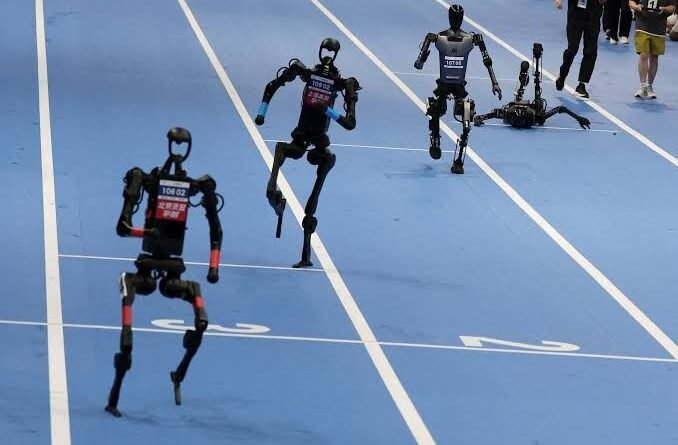
The standout performances came on the track. During the opening ceremony on 22 August, the Beijing-developed Tiangong Ultra, built by the government-backed Beijing Humanoid Robot Innovation Center (X-Humanoid), won a 100-metre preliminary heat in 9.39 seconds, bettering Usain Bolt’s human world record of 9.58 seconds set in 2009. Honor’s Lightning finished second in the same heat at 9.47 seconds. Both times represented a dramatic improvement on last year’s winning mark of 21.50 seconds by the same Tiangong model.
On Sunday the Tiangong Ultra platform returned to break the 400-metre record, finishing in 38.15 seconds – nearly five seconds quicker than Wayde van Niekerk’s human world record of 43.03 seconds from the 2016 Rio Olympics. In a standing high-jump demonstration, a Tiangong robot cleared 2.8843 metres, far above last year’s robotic best of under one metre and exceeding human standing high-jump marks.
The robots’ running styles lacked human grace. Many thrashed their arms, leaned precariously forward or wobbled before the finish. After crossing the line several slammed into thick foam safety mats; some stumbled into the sidelines or collapsed and had to be carried away.
Not every machine succeeded: some failed to start, others managed only a brisk walk, and a few crumpled shortly after the gun. The crowd of hundreds responded with cheers, laughter and applause for both the successes and the failures.
Organizers have placed greater emphasis on autonomy this year. Most track and competitive events must now be completed without remote control, with tighter time limits and scoring that favours independent operation. Twenty-one scenario contests simulate factory assembly, hotel and restaurant service, home housekeeping, logistics, emergency rescue and library work. A new dexterous-hand category challenges robots with precision tasks such as picking up beans with tweezers or assembling power tools.
The opening ceremony featured coordinated formations of dozens of robots that marched in step, formed the word “BEIJING,” performed synchronized routines and executed gymnastics moves. Humanoid machines played instruments alongside a human orchestra, exchanged tennis and table-tennis shots with former champions, and took part in a penalty shootout.
As competitions continue with weightlifting, freestyle combat, five-a-side football and all-round challenges still ahead, the Games provide a public snapshot of a technology advancing at speed. Human records have fallen on the track; the harder question is how quickly these machines will move from the arena into factories, homes and workplaces.
