
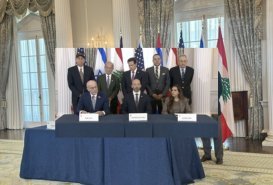
Lebanon and Israel Sign US-Brokered Framework Agreement
Lebanon and Israel have signed a US-mediated framework agreement aimed at advancing toward a comprehensive peace and security pact, marking a notable diplomatic step in their historically adversarial relationship.
The agreement was formally signed today at the US Department of State following months of trilateral negotiations. It builds on recent ceasefire extensions and establishes a structured pathway for addressing core security concerns while affirming the primacy of direct Lebanese-Israeli engagement.
US Secretary of State Marco Rubio, who hosted the signing ceremony, described the outcome as an “important step” toward peace. “The Lebanese people deserve to live in security and peace,” Rubio said. “The two negotiating teams did a wonderful job, and we are proud of what we have achieved… there is still a long way to go.”
The pact formalises and extends previous temporary understandings, including the April 2026 10-day cessation of hostilities and the June 4 renewal that introduced pilot security zones. It conditions the continuation of the ceasefire on Hezbollah’s full cessation of hostilities and withdrawal of its forces south of the Litani River. Lebanon has committed to deploying its Armed Forces to assume exclusive control in designated pilot zones, barring all non-state armed actors.
Both parties affirm mutual recognition of sovereignty and territorial integrity, commit to refraining from hostile acts, and agree to pursue direct US-facilitated negotiations on outstanding issues, including border demarcation. Lebanon pledged to enhance the capabilities of its national army with US support to enable effective nationwide control.
The agreement explicitly positions the future of Lebanon-Israel relations as a matter for the two sovereign governments alone, effectively sidelining external influence, particularly from Iran and its proxy Hezbollah.
The framework does not yet amount to full diplomatic normalisation or a formal peace treaty but lays groundwork for one, drawing on elements of UN Security Council Resolution 1701 while seeking more durable implementation mechanisms.
The signing follows intensive US-brokered talks, including a fourth high-level trilateral round on 2-3 June and follow-up sessions around 22 June. It comes against the backdrop of decades of conflict, sharply intensified by Hezbollah’s involvement in spillover from the 2023-2024 Gaza war. Earlier ceasefires in November 2024 and April 2026 faced repeated violations, necessitating extensions amid flare-ups that tested parallel regional de-escalation efforts involving Iran.
Israeli forces continue to hold positions in parts of southern Lebanon, while Hezbollah maintains a presence that has challenged implementation of prior agreements. Lebanese President Joseph Aoun has characterised recent diplomatic moves as a “last chance” for comprehensive resolution, stressing the need for full Lebanese sovereignty and army authority.
Significant hurdles remain, including practical implementation of pilot security zones, verifiable Hezbollah disarmament or redeployment, establishment of robust monitoring mechanisms, and a clear timeline for Israeli withdrawal.
As implementation begins, attention will focus on compliance in the pilot zones and whether the framework can withstand political pressures in Beirut and potential provocations. US officials continue to describe the accord as a foundation rather than a final outcome, with much work remaining for lasting peace between the two neighbours.
