
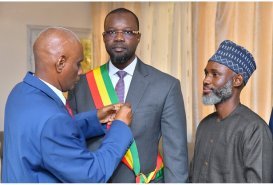
Ousted Prime Minister Ousmane Sonko Seizes Control of Senegal’s Parliament
Senegal’s National Assembly elected ousted Prime Minister Ousmane Sonko as its new Speaker on Tuesday, May 26, 2026, in a swift and dramatic political development that deepens the rift between Sonko and President Bassirou Diomaye Faye.
Sonko, the leader of the ruling Pastef party, secured 132 votes as the sole candidate after lawmakers first reinstated him as a Member of Parliament. He received a standing ovation from ruling coalition deputies, while opposition parties boycotted the session. The election hands Sonko significant institutional power just four days after President Faye dismissed him from the premiership and dissolved the government.
His emergence signals one of the fastest political comebacks in Senegal’s recent history and creates a potentially tense cohabitation dynamic between the presidency and the legislature, both controlled by the same party on paper.
Sonko, a former tax inspector and longtime anti-corruption advocate, built a strong youth following through his sharp criticism of elite corruption and foreign influence. Barred from running in the 2024 presidential election due to a defamation conviction, he threw his full support behind his ally Faye, who won a landslide victory. Sonko was appointed Prime Minister in April 2024, forming what many saw as a powerful tandem.
Tensions between the two leaders escalated over economic policy, particularly how to manage Senegal’s heavy public debt, which stands at around 130% of GDP. Debt servicing is now consuming a large portion of government revenue, complicating negotiations with the International Monetary Fund and crowding out spending on social services.
On May 22, President Faye abruptly dismissed Sonko and the entire cabinet, citing the need for new leadership to address the crisis. Economist Ahmadou Al Aminou Lo was appointed as the new Prime Minister on May 25.
As Speaker, Sonko gains substantial authority over parliamentary proceedings, budget oversight, legislation, and key appointments. With Pastef holding around 130 of 165 seats, the party’s lawmakers are expected to align closely with him, potentially creating checks on presidential power or leading to institutional gridlock at a time when Senegal faces serious economic challenges.
In his first remarks, Sonko pledged to work for stability and avoid chaos. However, the development has raised concerns about friction within the ruling coalition that propelled both men to power in 2024 on promises of systemic change, sovereignty, and youth empowerment.
Senegal, long been praised as one of West Africa’s most stable democracies is facing high youth unemployment, rising living costs, and questions over the management of recent oil and gas discoveries.
