
Rescuers Search Flooded Nepal Hydropower Tunnels
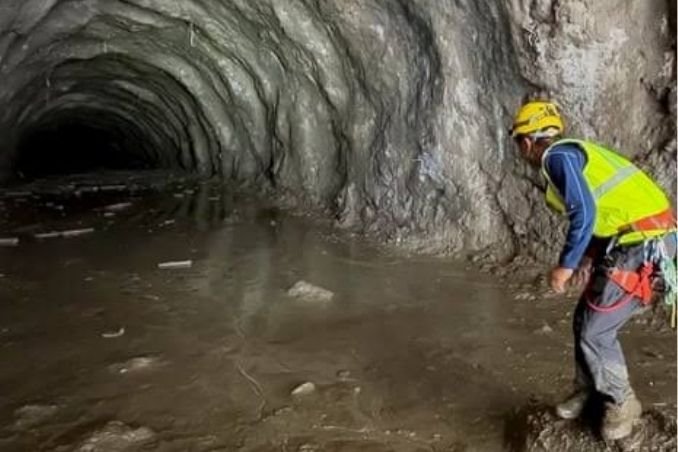
Indian tunnel specialists and the Nepali Army are searching flood-damaged hydropower sites in Chilime and Langtang, trying to reach workers still feared trapped in mud-filled tunnels after last week’s Himalayan disaster.
An 11-member Indian team of doctors, paramedics and tunnel engineers arrived on Friday at Kathmandu’s request and has been working in Rasuwa district since Saturday. On Sunday the team entered a tunnel near the Langtang project and recovered one body despite poor weather. At Chilime, two bodies were found about 100 metres inside a 250-metre tunnel.
Nepal’s National Disaster Risk Reduction and Management Authority put the toll on Monday at 903 dead and 4,247 missing, including 933 workers unaccounted for across 11 hydropower projects along the Bhotekoshi-Trishuli corridor. China reported 16 dead and 546 missing on the Tibetan side. Hundreds of unidentified remains have been buried in shallow graves as heat and humidity speed decomposition.
The flood began on the morning of 26 August when an ice-and-rock avalanche broke from about 5,200 metres on the north face of Langtang Lirung. Scientists said the collapse sent debris into the Lhende River and produced a fast-moving surge down the Bhotekoshi and Trishuli. Early studies have not treated the event as a classic glacial-lake outburst or as a storm-driven flood. The U.S. Geological Survey recorded the impact as equivalent to a magnitude 5.2 earthquake.
Hydropower works took the heaviest blow. The 216-megawatt Upper Trishuli-1 project accounts for the largest cluster of missing workers, with several hundred still unaccounted for inside its tunnels. The smaller 22-megawatt Chilime site reported six to eight people believed trapped. Teams have faced chest-deep mud, blocked portals and weather that repeatedly halted work. In some places they drilled holes to pass air while machines ran through the night to clear debris.
India also sent a 19-member forensic group to Kathmandu to help identify remains by DNA. China has dispatched tunnel specialists and more than 2,000 rescue workers. Prime Minister Balendra Shah said the Indian team flew reconnaissance and moved pumps and excavators to Chilime. Ambassador Naveen Srivastava and the Indian Embassy have described close coordination with the Nepali Army.
Nearly 21,000 Nepali security personnel are involved in the wider response. Officials warn that a full damage count is still impossible because roads, bridges and communications were torn out of remote valleys. Time is short for anyone who may still be alive in sealed tunnels, where air and access remain scarce. Rescue work at Chilime and Langtang is set to continue alongside Nepali forces.
