
Senegal Speaker Resigns to Clear Path for Ousmane Sonko’s Legislative Takeover
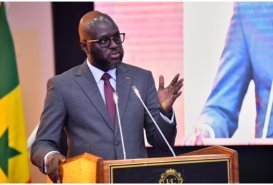
El Malick Ndiaye, President of Senegal’s National Assembly, announced his resignation on Sunday evening, May 24, 2026, just two days after President Bassirou Diomaye Faye dismissed Prime Minister Ousmane Sonko and dissolved the government.
In a lengthy, reflective statement posted on his verified X account, Ndiaye described the decision as the result of “profound reflection, matured in silence, responsibility, and a sense of the State.” He framed the resignation as being taken in “the superior interest of the Nation,” emphasising institutional stability, transparency and national cohesion. Ndiaye will retain his seat as a deputy but will no longer preside over the Assembly.
The timing is widely seen as a strategic and symbolic act of loyalty. Ndiaye, a longtime Sonko ally and PASTEF heavyweight who previously served as Minister of Infrastructure, is stepping aside to facilitate Sonko’s swift return to the legislature. Sonko had resigned his parliamentary seat upon becoming Prime Minister in April 2024 after backing Faye’s presidential victory. With PASTEF holding an overwhelming majority of roughly 130 out of 165 seats, Sonko is the clear favourite to be elected as the new President of the National Assembly when the chamber convenes in plenary session on Tuesday, May 26.
The National Assembly’s Bureau has already scheduled the urgent plenary for 9 a.m. on Tuesday. The agenda includes two main items: the formal reintegration of Ousmane Sonko as a deputy and the election of a new Assembly President. Observers describe this development as a rare case of a sitting president facing a de facto cohabitation with a legislature now even more firmly aligned with his former prime minister’s camp.
President Faye cannot constitutionally dissolve the Assembly before November 2026, meaning any new prime minister he appoints will have to work with a chamber that may now serve as a stronger counterweight.
The resignation deepens the visible fractures within the ruling PASTEF coalition that swept to power in the historic 2024 elections. What began as a powerful alliance between Faye and his charismatic mentor Sonko has unravelled over the past year amid disagreements on economic policy, debt management, IMF negotiations, and the pace of reforms. Public debt currently stands at around 132% of GDP, and tensions over austerity measures, oil and gas projects, and public spending transparency had become increasingly public.
Ndiaye’s departure adds to a growing list of PASTEF figures stepping back amid the rift. His statement expressed gratitude to deputies from both the majority and opposition, parliamentary staff, and party militants, striking a tone of statesmanship that has drawn widespread praise on social media. Supporters have hailed the move as an example of “dignity” and “fidelity,” while others interpret it as part of a calculated realignment that could strengthen Sonko’s influence even outside the executive branch.
The political realignment comes at a sensitive moment for Senegal, long regarded as one of West Africa’s most stable democracies. The country was praised internationally for its peaceful 2024 power transition, but the rapid breakdown of the Faye-Sonko partnership has introduced fresh uncertainty. President Faye must now form a new government while navigating a legislature likely to be led by his former prime minister.
For Sonko, returning to the National Assembly as its president would give him significant leverage over legislation, oversight and the national budget – powers that could either create healthy checks and balances or lead to institutional gridlock at a time when Senegal faces pressing economic challenges.
As Dakar awaits Tuesday’s session, the coming weeks will reveal whether this move stabilises the ruling coalition or accelerates its fragmentation. El Malick Ndiaye’s resignation may ultimately be remembered not merely as an exit, but as a deliberate act that reshapes the balance of power in Senegal’s democracy – prioritising party cohesion and institutional respect over personal position.
