
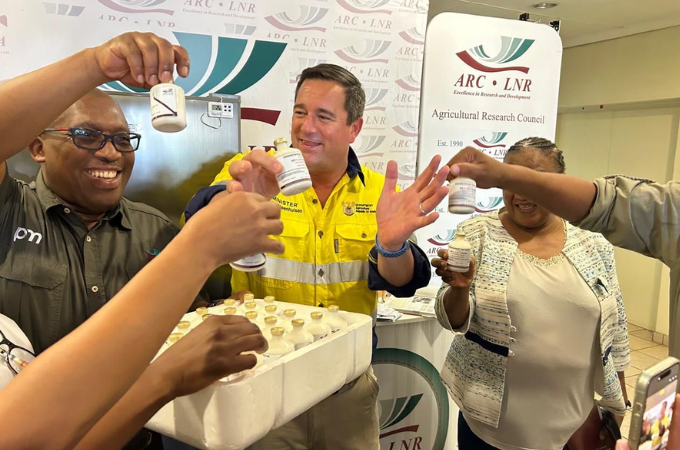
South Africa Announces First Locally Produced FMD Vaccines in 21 Years
South Africa has officially announced the production and registration of its first locally manufactured foot-and-mouth disease (FMD) vaccines in more than 21 years.
The breakthrough was publicly revealed on February 8, 2026, by the Agricultural Research Council (ARC) and the Department of Agriculture, Land Reform and Rural Development.
The announcement marks the culmination of development work that began in 2010, with key milestones including successful facility upgrades, clinical trials, and full regulatory registration secured in 2023. Local production at scale commenced in early 2026, allowing the country to begin manufacturing vaccines targeting the SAT1, SAT2, and SAT3 strains – the primary serotypes responsible for outbreaks in southern Africa.
The timing of the public rollout announcement on February 8 comes amid the country’s worst FMD outbreak in decades, which started in 2019 and led to the loss of South Africa’s internationally recognised FMD-free status (without vaccination). That outbreak triggered prolonged trade bans by major importing partners, severely affecting livestock farmers, meat prices, and export revenues.
FMD Outbreaks in Neighboring Countries (2024–2025)
Multiple SAT2 outbreaks in northern areas near Okavango Delta and Chobe National Park. Temporary export bans and vaccination campaigns followed. Zoning strict, but cross-border movement with Zimbabwe/Namibia remains risky.
Repeated SAT1/SAT2 outbreaks in Matabeleland and Mashonaland. Culling, restrictions, and limited vaccination due to funding/logistics. Cross-border cattle movement into SA/Botswana documented as transmission route.
SAT1/SAT2 outbreaks in Zambezi and Kavango East. Compartmentalisation protects export zones, but communal areas hit, causing temporary EU beef bans. Wildlife-livestock interface and informal trade with SA are major risks.
Sporadic SAT2 incidents in southern provinces (Gaza, Maputo) bordering SA/Zimbabwe. Vaccination and movement controls implemented. Limited veterinary infrastructure and informal trade heighten spread risk into SA.
SAT2 outbreak in Lubombo region. Temporary export restrictions imposed. Relies on vaccination and biosecurity; borders with SA/Mozambique increase exposure.
SAT strains (SAT1 & SAT2 dominant) endemic in southern Africa. Buffalo act as long-term carriers. Informal cross-border cattle movement, porous borders, and limited veterinary capacity facilitate spread. International trade bans cause severe economic damage when outbreaks occur.
Vaccine Development and Rollout Timeline
-
2010: ARC begins foundational research on local FMD vaccine strains.
-
2023: Vaccines complete registration process after years of trials and facility improvements.
-
Early 2026: Full-scale local production begins.
-
February 8, 2026: Official announcement of availability and rollout plan.
-
March 2026 (target): Production scales to 20,000 doses per week.
-
2027 (target): Production reaches 200,000 doses per week.
-
Within 12 months (target): Regain FMD-free status through vaccination, surveillance, and biosecurity.
The vaccines are formulated using South African field isolates, offering better match and efficacy against local strains compared to some imported alternatives. Officials have prioritised high-risk areas near borders and communal grazing lands where outbreaks have been most severe.
Economic and Trade Impact
The FMD crisis has cost the South African economy billions of rands in lost exports, higher domestic meat prices, and compensation for culled animals. The livestock sector, valued at approximately R60 billion, has faced repeated movement restrictions, culling, and vaccination campaigns. The new locally produced vaccines are expected to reduce dependence on imports, lower costs, improve availability during outbreaks, and support efforts to restore international market access.
Farmers, livestock associations, and veterinary experts have welcomed the announcement as a critical step toward self-reliance and resilience. They have stressed the need for sustained government funding, consistent production, and effective distribution to high-risk zones.
The February 8 announcement signals a turning point in South Africa’s fight against FMD, with hopes that local vaccine production will help end the cycle of trade bans and economic disruption that has plagued the sector since 2019.
