
Trump Confirms Death of ISIS Second-in-Command Abu-Bilal al-Minuki in Joint U.S.-Nigeria Operation
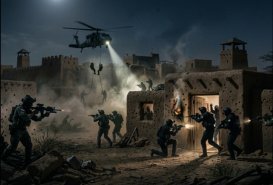
President Donald Trump has announced that United States and Nigerian special forces carried out a successful joint operation that resulted in the death of Abu-Bilal al-Minuki, the second-in-command of the Islamic State group globally.
According to a statement released by the president on Truth Social and amplified by the White House on X, the meticulously planned raid took place within the past 24 hours on African soil, dealing a significant blow to the terrorist organisation’s leadership structure.
Al-Minuki, also known by aliases including Abu Bakr ibn Muhammad ibn ‘Ali al-Mainuki and Abubakar Mainok, was a Nigerian national born in 1982 in Mainok, Borno State. He had risen to prominence within ISIS networks, particularly through the Islamic State West Africa Province and the group’s General Directorate of Provinces.
Trump described the mission as flawlessly executed, stating that al-Minuki “thought he could hide in Africa” but was tracked through reliable intelligence sources. “He will no longer terrorize the people of Africa, or help plan operations to target Americans,” the president said. He thanked the Nigerian government for its partnership and framed the success as part of a broader strategy to pursue terrorists wherever they operate.
Al-Minuki had been designated a Specially Designated Global Terrorist by the United States in 2023 for his senior role in ISIS’s external operations coordination, particularly in the Sahel and Lake Chad Basin regions. Prior to his elevation to global deputy, he served as a regional commander and finance facilitator within ISWAP, a faction that broke away from Boko Haram and pledged allegiance to ISIS. His activities included coordinating attacks, managing resource flows and maintaining links between ISIS core leadership and African affiliates.
The death of such a high-ranking figure represents a notable disruption to ISIS’s decentralised command. After losing its territorial caliphate in Syria and Iraq in 2019, the group has increasingly relied on regional provinces in Africa to sustain its global relevance. The Lake Chad Basin has become one of its most active theatres, where insurgents have exploited local grievances, porous borders and governance challenges to carry out violence that has killed thousands and displaced millions.
This joint raid builds upon strengthened bilateral security ties that gained momentum in late 2025. Following US airstrikes on ISIS targets in Nigeria’s northwest on Christmas Day that year, Washington increased its support with advisers, intelligence sharing and drone capabilities. Nigerian authorities have credited the partnership with neutralising numerous militants in recent months.
Details of the specific raid, including the exact location and operational tactics, remain classified. Neither the US Department of Defense nor Nigerian Defence Headquarters had issued separate confirmations as of early Saturday, though multiple reports emerged based on the presidential announcement.
Standard protocol for such high-value counterterrorism missions often limits immediate public disclosure to protect sources and methods. The operation occurs as Africa has emerged as a primary battleground for ISIS, with the group shifting focus from the Middle East to take advantage of instability across the Sahel and West Africa.
Al-Minuki’s role in the Maktab al-Furqan office made him instrumental in translating central directives into local action, including financing and propaganda efforts. His removal is expected to hamper coordination between ISIS leadership and its African branches, at least in the short term.
Counterterrorism experts caution that while leadership decapitation strikes degrade operational capacity, they rarely eliminate the underlying ideology or local drivers of recruitment such as poverty, ethnic tensions and competition with other jihadist groups like al-Qaeda affiliates.
Nevertheless, such actions buy time for regional governments to address governance and development deficits. In Nigeria, reactions have been mixed. Many citizens affected by long-running insurgencies in the northeast welcomed the news as justice for victims, particularly Christian communities and farmers targeted in repeated attacks. Others expressed cautious optimism about deeper US involvement, while some voices raised questions about sovereignty and the implications of foreign forces conducting operations on Nigerian territory.
President Trump positioned the mission within his administration’s “peace through strength” approach, signalling continued resolve to confront terrorist threats regardless of location. The success comes after a series of high-profile ISIS leadership losses under his second term, echoing earlier operations against figures such as Abu Bakr al-Baghdadi.
The partnership with Nigeria reflects broader US strategic interests in West Africa, where ISIS and other groups have exploited security vacuums. Enhanced cooperation has included intelligence sharing, training programmes and occasional direct support, aimed at bolstering local forces without large-scale American troop deployments.
As more details potentially emerge from official briefings, the focus will shift to assessing the broader impact on ISIS operations in West Africa. Both US and Nigerian authorities are expected to provide further updates in the coming hours or days while maintaining operational security.
