
U.S. and Iran Hold UN Talks
President Donald Trump said American and Iranian officials spent three hours in contact on the sidelines of the United Nations General Assembly on Tuesday, called the session “very good” and “very productive,” and said another meeting is already set “in the very near future” – hours after he told the same hall that Iran faced “potential greatness or obliteration.”
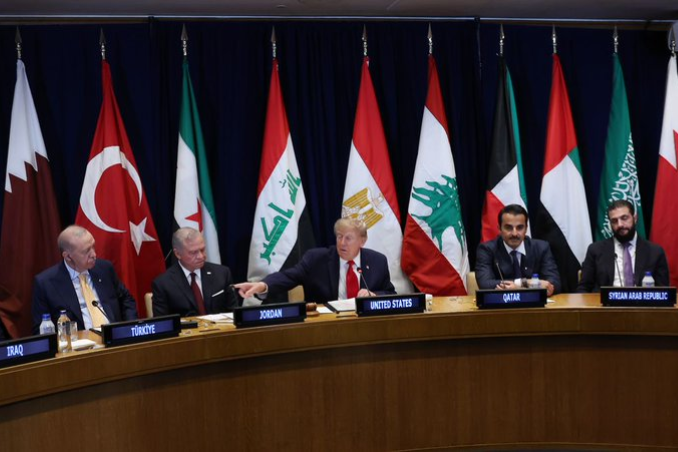
He spoke after a gathering with Gulf Cooperation Council leaders that also included Turkish President Recep Tayyip Erdoğan, and said the New York contact had ended about an hour earlier. He named Steve Witkoff, his special envoy, and Jared Kushner as the U.S. participants. Witkoff told reporters he felt “very good right now.” How the two sides actually sat is still disputed. Trump first described the encounter as if his envoys had met the Iranian team. Witkoff later wrote that talks ran “through the mediators, who shuttled between the two sides throughout the day.” Reports citing Iranian officials and Western outlets have named Qatar and, in some versions, Pakistan. Iranian state media said Foreign Minister Abbas Araghchi took part and that Tehran agreed at Washington’s request.
Iran used the channel to set a price for reopening the Strait of Hormuz, Iranian state television said: an end to the U.S. naval blockade of Iranian ports, the release of frozen assets, and a halt to fighting “on all fronts,” including Lebanon. A senior Iranian official told Reuters the waterway could reopen in about seven days if Washington eased military pressure and lifted the blockade. Secretary of State Marco Rubio said there was “no harm in engaging.” President Masoud Pezeshkian is in New York and was due to address the Assembly on Wednesday; a meeting with Trump was widely treated as unlikely.
The exchange sits inside a war now approaching seven months, after talks collapsed and U.S. and Israeli operations intensified in late February. A June memorandum in Switzerland involving Vice President JD Vance, Witkoff and Kushner did not hold. Trump said he thinks a deal could follow the November midterms and that one is in Iran’s interest.
The same afternoon, he used a 37-minute General Assembly speech to call Iran the world’s “number one sponsor of terror,” to say he would never allow it a nuclear weapon, and to ask whether Washington should let Tehran rebuild or “annihilate the Islamic Republic.” Iranian and Cuban delegates walked out during parts of the address. He tied the 25th anniversary of 11 September and the third anniversary of the 7 October 2023 Hamas attack to Iranian sponsorship, claimed a 20-point Gaza plan had unanimous Security Council backing and the return of remaining hostages, and said Ukraine could be settled “more quickly than people understand.” He listed eight wars or disputes he claimed he had closed by personal diplomacy, trade and tariffs.
Elsewhere he defended the capture of former Venezuelan president Nicolás Maduro and an oil agreement he called the largest in history – “To the victor belong the spoils”, designated cartels as terrorist groups, predicted Cuba’s government “will fall,” and referred to a Greenland security arrangement. He boasted of a 15 percent cut to the UN budget and more than 4,000 jobs gone, told members to leave the International Criminal Court, and said official U.S. papers would now say “super intelligence” instead of artificial intelligence. He opened with America’s 250th year, “the envy of the world” economy, more than a million private-sector jobs and record real household incomes – claims his critics set against the cost of the Iran campaign and inflation.
