
BRICS Issues New Delhi Declaration
Leaders of the 11-member BRICS group adopted a 140-point declaration in New Delhi on Saturday, condemning sanctions imposed outside the U.N. Security Council and calling for “maximum restraint” in the Middle East after months in which Iran and Gulf members could not even agree a joint ministerial text.
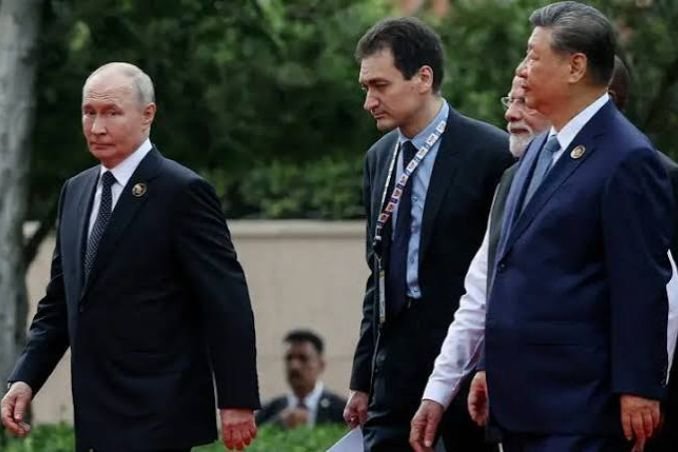
Prime Minister Narendra Modi said the New Delhi Declaration 2026 was accepted without objection at the 18th summit, held under India’s theme of resilience, innovation, cooperation and sustainability and on the grouping’s twentieth year. Overnight talks produced language loose enough for Iran and the United Arab Emirates to live with: deep concern at “continued escalation” in West Asia, a plea to avoid steps that would make it worse, and no naming of particular strikes or parties. Foreign ministers had failed to issue a statement in May. Chinese President Xi Jinping told the summit the Middle East war “does not serve the common interests of the international community.” Iranian President Masoud Pezeshkian, who has said the region does not need an American “policeman,” met Abu Dhabi Crown Prince Khaled bin Mohamed bin Zayed on the sidelines.
The document treats unilateral coercive measures – including economic and secondary sanctions not authorised by the Security Council, as contrary to international law, harmful to rights, health, food security and development, and due for elimination. It also objects to rising tariffs and non-tariff barriers that it says break World Trade Organization rules, and wants the WTO’s dispute system restored in full. The text does not name Washington or Brussels. Western governments have already treated BRICS expansion and its line on sanctions with suspicion; the United States has previously called parts of the project anti-American and floated further tariffs.
BRICS now accounts for about 40 percent of world output and, in Modi’s figures, half the world’s people and more than a quarter of trade. The declaration calls the post-1945 order outdated and asks for comprehensive U.N. reform, including the Security Council. China and Russia restated support for a larger role for India and Brazil, including in the Council. Modi said the Global South should be a “rule-shaper,” not a “rule-taker,” and that a “pyramid of privilege” should become a “platform of partnership.” Vladimir Putin called BRICS the largest association of its kind by several measures. Xi called it the most influential platform for emerging markets and developing countries.
The New Development Bank was described as central to infrastructure in the Global South. Leaders want more lending in local currencies, a wider funding base and faster consideration of new members. The Shanghai-based bank has approved about $43 billion of projects in its first decade. The text also backs sovereign control and benefit-sharing in critical minerals, diversified supply chains, and energy transitions that still leave room for fossil fuels in many developing economies.
On Palestine, the leaders voiced concern that violence in Gaza has continued despite a 2025 ceasefire, demanded open humanitarian access, opposed forced displacement and restated a two-state outcome on 1967 lines with East Jerusalem as the capital of a sovereign Palestinian state. They supported full U.N. membership for Palestine, UNRWA and International Court of Justice measures on aid, and criticised the politicisation of humanitarian help.
The grouping condemned the 22 April 2025 attack in Pahalgam, Jammu and Kashmir, which killed 26 people – a line India obtained even from China, and rejected any tying of terrorism to a religion or nationality. It called for action against cross-border movement, financing and safe havens, and for work on a Comprehensive Convention on International Terrorism. Other pledges cover peaceful use of outer space and no arms race there, protection of cultural heritage in war, and AI cooperation so the Global South is not only a consumer of the technology.
