
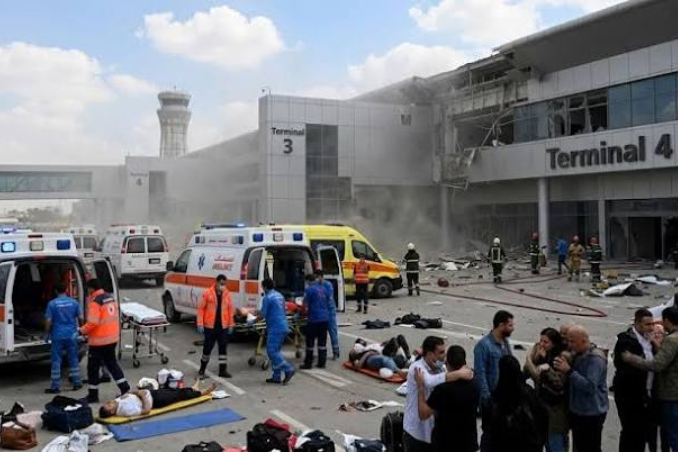
Saudi Airports Under Repeated Attack
Saudi Arabia’s civil aviation authority says King Fahd International Airport in Dammam was targeted on Sunday evening, hours after a second strike on Riyadh’s King Khalid International Airport, as a new report suggests Saudi officials fear the kingdom is running short of the interceptor missiles.
The General Authority of Civil Aviation (GACA) said teams were assessing damage and carrying out safety inspections at the Dammam airport in coordination with other agencies. It described the incident as part of a series of attacks on civilian aviation facilities across the kingdom. Separately, Saudi-led coalition spokesman Maj. Gen. Turki al-Malki said on X that air defences had intercepted and destroyed a drone in the Eastern Province, where Dammam is located. The reports do not say who launched the attack on Dammam or whether anyone was hurt.
In Riyadh, an unidentified projectile struck Terminal 4 on Sunday, causing a fire and injuries, Saudi authorities said, according to Al Arabiya English. The coalition said it also intercepted and destroyed a cruise missile near the airport. The Saudi Civil Aviation Authority later said one person, a Pakistani resident, was killed and 11 were injured, with material damage still being assessed. The Times of Israel, citing agency reports, described the strike as a fresh Houthi attack on the same terminal.
The Sunday strike came a day after a far deadlier attack on the same airport. The civil aviation authority put that toll at 12 dead and more than 300 wounded, though a US Federal Aviation Administration notice cites 13 dead. The coalition called the attack a war crime and vowed a response.
The Houthis, the Iran-backed group in Yemen, have since issued a new threat to Saudi airspace and said Riyadh had launched strikes on Sanaa. Pakistan’s prime minister condemned the attack as “heinous,” and Saudi Arabia, Egypt, Pakistan and Turkey have jointly demanded an immediate halt to Houthi attacks. Israeli Prime Minister Benjamin Netanyahu also condemned it.
The coalition said it separately intercepted a Houthi ballistic missile fired toward Khamis Mushait in southern Saudi Arabia.
The Wall Street Journal, citing Saudi officials and people familiar with the kingdom’s thinking, reported that Riyadh is running low on interceptor missiles and is struggling to cover the country with air defences. It said missile batteries are being moved around to protect key energy infrastructure and royal palaces, and that Crown Prince Mohammed bin Salman is moving between heavily guarded palaces equipped with bunkers. Saudi authorities have not commented on the report in the material available.
The FAA has warned US airlines to exercise caution when flying to or over Saudi Arabia until 10 December, citing threats linked to military activity and navigation-system interference. It said the risks could affect aircraft at all altitudes, including during overflight, arrival and departure. Australian Foreign Minister Penny Wong condemned the “unacceptable” Houthi attacks and advised Australians against travelling to King Khalid International Airport.
In a separate regional incident, the UK Maritime Trade Operations agency said a tanker near the Sohar anchorage in Oman was struck by a drone. Local authorities are helping evacuate the crew, and the extent of the damage and any environmental impact are unknown. The agency did not say who was responsible, and nothing in the material links it to the attacks on Saudi Arabia.
The attacks come after full-scale fighting returned to Yemen. The Times of Israel, citing agency reports, said Yemeni forces were advancing near the Bab el-Mandeb Strait and that 63 people were reported killed in clashes with Houthi fighters.
