
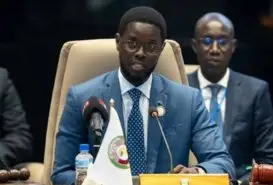
Senegal Secures Dual Leadership Roles in ECOWAS
Senegal’s President Bassirou Diomaye Faye assumed the rotating chairmanship of the Economic Community of West African States (ECOWAS) on Saturday, while one of his top generals was elected to head the regional bloc’s executive arm.
The double appointment, sealed at the 69th ordinary session of ECOWAS heads of state in Freetown, Sierra Leone, gives Dakar unprecedented influence over both the political direction and day-to-day operations of the 15-nation organisation.
Faye, 46, who has led Senegal since April 2024, was designated President-in-Exercise of the Conference of Heads of State and Government. In brief remarks, he thanked fellow leaders for the confidence placed in Senegal and pledged to work toward “a strong, united and prosperous West Africa.”
The summit simultaneously elected General Birame Diop, Senegal’s former armed forces minister and ex-chief of defence staff, as President of the ECOWAS Commission. Diop, an air force general with prior experience as military adviser to the UN Secretary-General, will assume office on 1 September in Abuja for a four-year term. Security sector reform and counter-terrorism cooperation are expected to feature prominently on his agenda.
The dual Senegalese leadership is rare in recent ECOWAS history and underscores Dakar’s rising diplomatic profile under Faye’s administration. Analysts interpret the choice of a senior military figure to run the Commission as a signal of heightened focus on stabilising the Sahel and coastal states amid jihadist insurgencies and political transitions.
Faye congratulated Diop and assured him of full Senegalese support. The appointments come at a challenging time for the bloc, which continues to manage tensions with Mali, Burkina Faso and Niger — the three countries that announced their withdrawal last year to form the Alliance of Sahel States.
Discussions in Freetown emphasised revitalising free movement of people and goods, advancing the regional currency project, and strengthening joint security mechanisms. Official communiqués remained measured on ongoing political situations in member states.
Faye’s assumption of the chair follows his landslide election victory in Senegal on a platform of sovereignty, anti-corruption and youth empowerment. His selection of Diop, a career soldier with extensive international experience, is seen as a deliberate emphasis on security in Senegal’s regional policy.
No major disputes were reported during the leadership elections, indicating broad consensus among attending heads of state.
With Faye steering political decisions and Diop managing the Commission, Senegal now holds significant sway over West Africa’s premier integration body. The coming months will test how this influence translates into progress on trade, security and democratic stability.
