
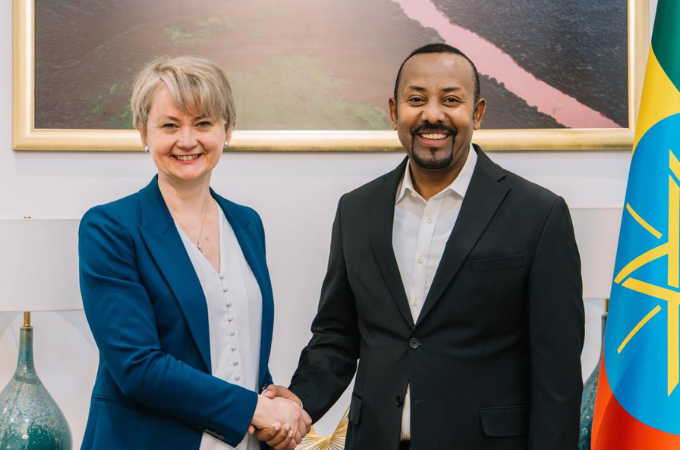
UK Foreign Secretary Yvette Cooper Visits Ethiopia to Strengthen Ties, Sign Energy Deals, and Tackle Migration Routes
British Foreign Secretary Yvette Cooper concluded a high-stakes mission to Ethiopia on Monday, February 2, 2026, marking a pivotal shift in the UK’s post-2025 “New Approach to Africa.”
The visit, Cooper’s first to the continent since taking office, successfully bridged the gap between industrial development and domestic UK border policy, resulting in nearly £300 million ($400 million) in energy commitments and a new strategic framework for migration management.
The Strategy: From “Donor” to “Investor”
The centerpiece of the visit was a clear departure from traditional aid models. By signing a Memorandum of Understanding (MoU) under the Ethiopia Investment Advisory Facility, the UK is pivoting toward technical cooperation on public asset management. The goal is simple: transform Ethiopia’s economy into a job-creating engine that provides an alternative to the perilous “small boat” journeys across the English Channel.
“The focus is on partnerships that create good jobs at home so people can build a better future without risking their lives on perilous journeys,” Cooper stated, following meetings with Ethiopian Prime Minister Abiy Ahmed and Foreign Minister Gedion Timothewos.
Powering the Future: Key Energy Agreements
The most tangible outcome of the trip involves two massive infrastructure projects led by Gridworks, a UK-backed investment firm. These projects are designed to stabilize Ethiopia’s grid and facilitate the distribution of the country’s massive hydropower potential.
| Project Name | Scope | Strategic Impact |
| Hurso–Aysha Project | 400 kV Transmission | Connects industrial hubs; boosts export capacity. |
| Degehbur–Kebridehar | 132 kV Transmission | Reinforces the eastern grid; supports rural electrification. |
| Investment Facility | Technical Advisory | Optimizes public investment & asset management. |
The Migration Link: Tackling the “Upstream” Crisis
Cooper’s visit was underscored by a blunt reality: roughly 30% of irregular arrivals in the UK over the last two years have originated from the Horn of Africa (Ethiopia, Eritrea, Somalia, and Sudan). The Foreign Secretary’s “upstream” strategy focuses on:
-
Job Creation: Using the £300m energy funding to create thousands of local industrial roles.
-
Law Enforcement: Enhancing bilateral cooperation to dismantle smuggling cartels.
-
Humanitarian Buffer: A separate £17 million package was announced to combat acute malnutrition and gender-based violence, targeting the immediate suffering that often precedes displacement.
Regional Diplomacy & AU Engagement
Beyond bilateral deals, Cooper met with AU Commission Chairperson Moussa Faki Mahamat. The discussions centered on the ongoing humanitarian catastrophe in Sudan and the transition of security operations in Somalia. The UK reaffirmed its commitment to the African Union’s Agenda 2063, signaling that London is finally ready to “think with Africa, not do for Africa.”
For Prime Minister Abiy, the visit signaled a normalization of relations following the strain of the 2020–2022 Tigray conflict. While implementation of the Pretoria Agreement remains a point of international observation, the UK’s willingness to sign long-term infrastructure deals suggests a renewed confidence in Ethiopia’s regional stability.
