
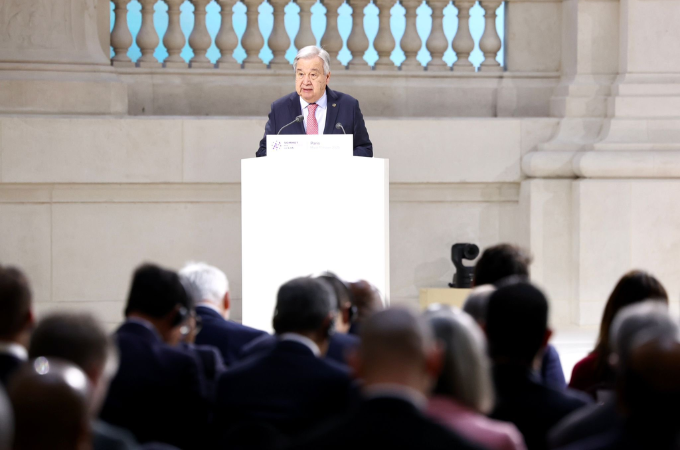
UN Secretary – General Guterres Names 40 Experts to Lead Global AI Scientific Panel
UN Secretary-General António Guterres has warned that artificial intelligence is advancing “at the speed of light” and called for urgent global cooperation to establish effective guardrails, unlock innovation for the common good, and separate “fact from fakes, and science from slop.”
Announcing the creation of the International Scientific Panel on AI – the first fully independent global scientific body dedicated to assessing AI’s real impacts – Mr. Guterres emphasized the need for shared understandings to manage the technology’s transformative power.
A Vision for Humanity: Closing the “AI Divide”
The Panel’s roots trace back to 2023, following the public release of ChatGPT and other generative AI systems that heralded a new era in the field. In response, Mr. Guterres convened leading technologists and academics to develop recommendations for safe and inclusive AI governance. Their vision, crystallized in the 2024 report Governing AI for Humanity and the Global Digital Compact, called for an independent, UN-supported scientific panel to close the widening AI knowledge gap.
One of the Panel’s primary missions is to prevent a future of AI “haves” and “have-nots.” By providing a centralized, authoritative reference point, the UN aims to ensure that developing nations have the same access to scientific evidence and risk assessments as tech-heavy nations, thereby narrowing the digital divide.
“This is not just about technology — it is about humanity,” Mr. Guterres said. “We need shared understandings to build effective guardrails, unlock innovation for the common good, and foster cooperation. The Panel will help the world separate fact from fakes, and science from slop.”
Meet the Nominees: A Global Brain Trust
Following a global call that drew over 2,600 applications, 40 prospective members — 19 women and 21 men — have been nominated for consideration by the UN General Assembly. Nominees were selected for their globally recognized expertise, with a strict emphasis on geographical representation.
Notably, these experts serve in their personal capacity, meaning they are independent of any government, company, or institution.
| Proposed Member | Region / Affiliation | Expertise Focus |
| Sonia Livingstone | UK (LSE) | Media literacy, childhood development, and digital rights |
| Balaraman Ravindran | India (IIT Madras) | Data science, machine learning, and AI impact |
| Maria Ressa | Philippines (Nobel Laureate) | Journalism, disinformation, and tech’s societal impact |
| Yoshua Bengio | Canada (Mila/U. Montreal) | Deep learning and AI safety |
| Tuka Alhanai | UAE (NYUAD) | Emotional AI and human-machine interaction |
| Melahat Bilge Demirköz | Türkiye (METU) | High-energy physics and scientific data processing |
| Vipin Kumar | USA (U. Minnesota) | Data mining and climate modeling |
| Girmaw Abebe Tadesse | Ethiopia (Microsoft Research) | Health informatics and AI for social good |
Bridging the Geopolitical Divide
UN Special Envoy on Technology, Amandeep Gill, acknowledged the challenges of forging consensus amid rising technological rivalry and “AI nationalism.” Drawing a historical parallel, he noted: “Even during the Cold War, scientists from across the world were able to work together on issues of international importance. It’s one of the value-adds of the United Nations to provide those mechanisms.”
The Panel will conduct “deep dives” into priority areas such as healthcare, energy efficiency, and education, providing yearly assessments of AI’s risks and opportunities.
Timeline and Next Steps
The General Assembly is expected to finalize the membership on February 12, 2026. The body is on a “fast track,” with its first major report scheduled for delivery by July 2026. This report will serve as the scientific foundation for the first Global Dialogue on AI Governance, set to take place during the AI for Good Global Summit in Geneva
