
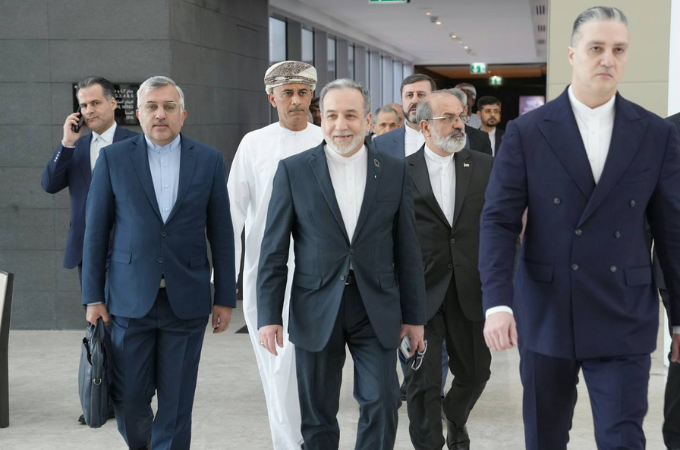
U.S.-Iran Nuclear Talks in Oman: Tehran Reports “Positive Start” to Indirect Negotiations
Iranian Foreign Minister Abbas Araghchi has described indirect discussions with U.S. officials in Oman on February 6, 2026, as a “very good start” and “positive,” following mediation by Omani authorities.
The talks focused narrowly on Iran’s nuclear programme, amid heightened regional tensions and fears of military escalation.
Araghchi told reporters in Muscat that both sides agreed to continue consultations after returning to their capitals. He stressed that future rounds must proceed “without threats” and remain confined to the nuclear issue from Iran’s perspective. Omani Foreign Minister Badr al-Busaidi met separately with the delegations, with the U.S. side represented by Special Envoy Steve Witkoff and White House adviser Jared Kushner.
Omani officials called the consultations “very serious” and aimed at laying groundwork for resumed diplomatic and technical negotiations. No major breakthroughs were announced, but the willingness to continue marks the first notable diplomatic engagement since U.S. military strikes on Iranian nuclear facilities in 2025.
Oman’s Long-Standing Mediation Role
Oman has a proven track record as a discreet, neutral mediator in U.S.-Iran diplomacy. It facilitated secret talks that led to the 2015 Joint Comprehensive Plan of Action (JCPOA) nuclear deal and hosted back-channel communications during periods of acute tension, including after the U.S. withdrawal from the JCPOA in 2018 and the 2020 killing of Qassem Soleimani. Muscat’s quiet diplomacy, rooted in its policy of non-alignment and good relations with both Washington and Tehran, has repeatedly provided a safe venue for indirect dialogue when direct contact is politically impossible.
History and Development of Iran’s Nuclear Programme
Iran’s nuclear programme dates back to the 1950s under the U.S.-backed “Atoms for Peace” initiative. It expanded in the 1970s with plans for power reactors but was disrupted by the 1979 Islamic Revolution. The programme resumed secretly in the 1980s and 1990s, with revelations in 2002 of undeclared facilities at Natanz and Arak sparking international concern.
Key milestones:
-
2003–2005: EU-3 (UK, France, Germany) negotiations; Iran suspends enrichment temporarily.
-
2006–2013: UN Security Council sanctions; Iran accelerates enrichment to 20% and installs advanced centrifuges.
-
2015: JCPOA signed — Iran caps enrichment at 3.67%, reduces centrifuges, fills Arak reactor core, and accepts intrusive IAEA monitoring in exchange for sanctions relief.
-
2018: U.S. withdraws from JCPOA under Trump, reimposes “maximum pressure” sanctions.
-
2019–2025: Iran progressively breaches JCPOA limits (enrichment to 60%, advanced centrifuges, reduced IAEA access), citing U.S. non-compliance.
-
2025: U.S. conducts strikes on nuclear sites; Iran accelerates to near-weapons-grade (90%+) enrichment in response.
The programme has produced enough enriched uranium for several nuclear weapons if further enriched, though U.S. intelligence assesses Iran has not yet decided to weaponize. The IAEA continues to report gaps in monitoring and undeclared activities.
Build-Up to Current Talks
Tensions escalated sharply in 2025 with U.S. strikes on Iranian facilities, Iranian proxy attacks on U.S. interests, domestic unrest in Iran, and threats of further military action. Trump’s second-term administration has combined threats (“big U.S. warships heading to Iran”) with offers of negotiation, while Tehran has insisted on sanctions relief and no expansion of scope to missiles or regional issues.
Oman’s mediation has been crucial in preventing total breakdown. The current round reflects mutual interest in avoiding war – the U.S. faces domestic pressure to avoid another Middle East conflict, while Iran seeks sanctions relief amid economic strain.
Impact on Oil Prices
The talks have contributed to a notable easing of oil prices. Brent crude fell sharply (3-5% in recent sessions) as the geopolitical risk premium – built up by fears of strikes on Iran or closure of the Strait of Hormuz – unwound. Prices remain volatile and headline-driven, with informed observers expecting choppy trading in February. A firm U.S. dollar and bearish fundamentals (well-supplied inventories, slower demand growth) add downside pressure, though any breakdown in talks could quickly reverse the decline.
While not a breakthrough, the “positive start” in Oman offers cautious optimism for de-escalation, with oil markets closely watching follow-up developments.
