
ECOWAS Establishes New Regional Force to Fight Jihadists as Spain Funds €16m Resilience and Inclusion Programme
The Economic Community of West African States (ECOWAS) is moving on parallel tracks to strengthen both security and development across the region.
Military chiefs from the bloc’s 12 remaining member states have agreed to create a new standby force to combat jihadist insurgencies and transnational organized crime, while ECOWAS and Spain’s Agency for International Development Cooperation (AECID) have formally launched a €16 million (approximately $19 million) cooperation programme for 2025 – 2028 focused on resilience, inclusion, and sustainable integration.
According to sources cited by AFP, the decision to establish the new force was taken during a meeting of chiefs of defence staff in Freetown over the weekend of March 1 – 2, 2026. The discussions centred on the persistent and expanding terrorist threat, maritime insecurity, and the spread of organised crime networks. The initial target is to have approximately 2,000 troops ready for deployment, stationed primarily in their home countries with Sierra Leone designated as the logistical hub.
While financing details and the exact operational framework are still under negotiation, ECOWAS has not yet issued an official statement. A senior West African military official emphasised that the three AES states – Burkina Faso, Mali, and Niger – remain critical to the fight against jihadism, describing them as “the epicentre” of the threat. He indicated that cooperation with the AES would be actively encouraged despite their 2024 – 2025 withdrawal from ECOWAS following military coups.
The Sahel region, spanning the semi-arid belt between the Sahara and sub-Saharan Africa, has been severely affected by jihadist groups affiliated with Al-Qaeda and Islamic State. Violence has been most intense in Burkina Faso, Mali, and Niger, where insurgencies have displaced millions, disrupted livelihoods, and overwhelmed national security forces. ECOWAS’s proposed force reflects a renewed determination to address the threat collectively after earlier regional mechanisms faced challenges.
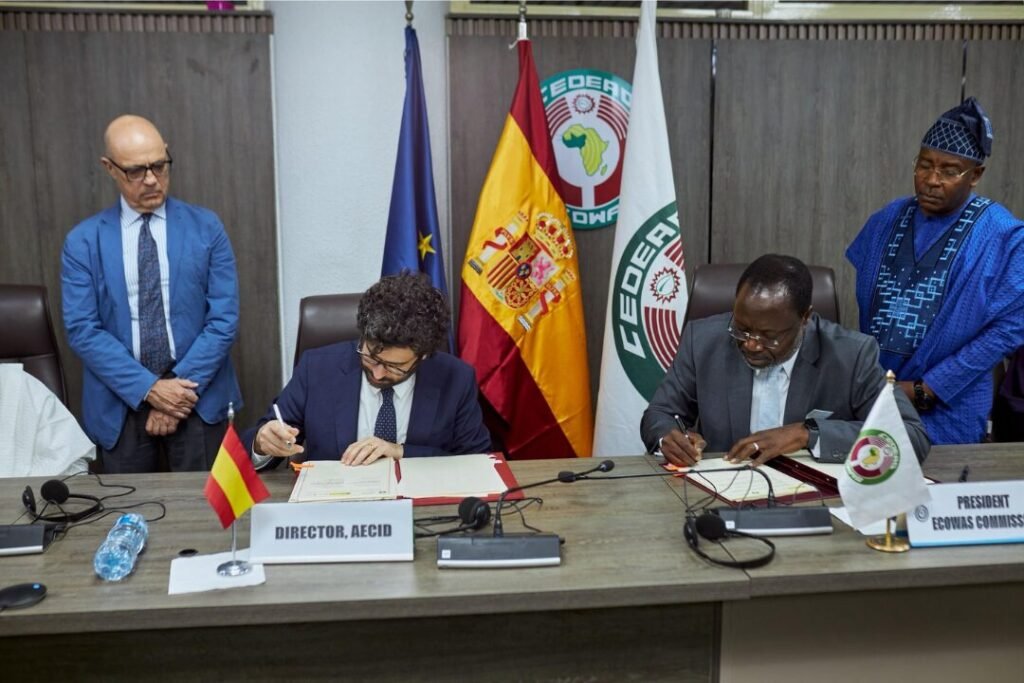
Simultaneously, ECOWAS and AECID launched their €16 million programme in Abuja on March 4, 2026, building on two Memoranda of Understanding signed on February 23, 2026, between ECOWAS Commission President Dr Omar Alieu Touray and AECID leadership. The initiative aligns with ECOWAS Vision 2050 and prioritises four core areas:
-
Rural development
-
Sustainable agri-food systems and food security
-
Access to clean energy
-
Gender equality, equity, and empowerment of women and girls
Additional focus will be placed on agriculture, infrastructure, energy access, and institutional capacity building to deliver tangible benefits, especially in rural communities.
ECOWAS President Touray described the pact as the largest cooperation agreement between any African Regional Economic Community and a bilateral donor, characterizing it as a partnership of mutual interest rather than traditional aid. AECID Director Antón Leis García reaffirmed Spain’s long-term commitment to West Africa, framing the programme as a transformative step toward sustainable development and regional stability.
Spain’s engagement with ECOWAS builds on previous collaborations in aquaculture, livestock development, animal feed innovation, and circular economy projects in Benin, Nigeria, Senegal, and other member states. The new programme is expected to roll out concrete initiatives over the next three years, coordinated through ECOWAS institutions and AECID’s regional cooperation office.
The dual announcements – security and development – highlight ECOWAS’s strategy to address interconnected challenges: jihadist violence and organised crime erode livelihoods and governance, while food insecurity, energy poverty, gender disparities, and weak infrastructure perpetuate instability. Both efforts aim to strengthen state capacity, protect vulnerable populations, and foster inclusive growth across West Africa.
As the region confronts persistent insurgencies in the Sahel and Lake Chad Basin alongside broader humanitarian and economic pressures, these initiatives signal a renewed push for coordinated regional responses supported by international partners.
