
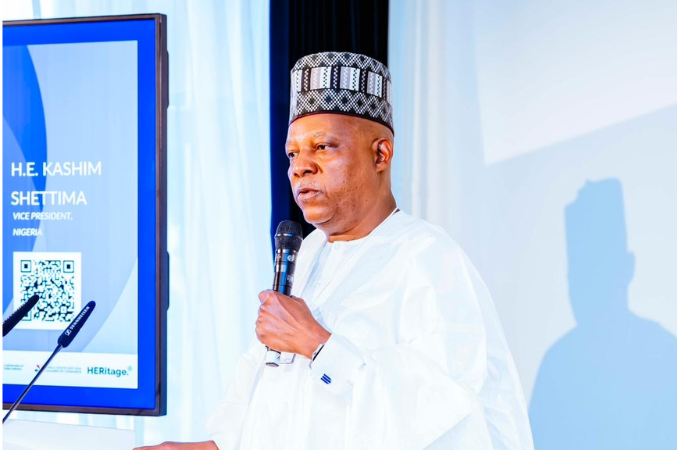
Vice President Shettima: Nigeria Poised to Shape Africa’s Future Through Inclusion, Investment, and Impact-Driven Partnerships
Vice President Kashim Shettima has reaffirmed Nigeria’s commitment to shaping Africa’s future through deliberate impact, inclusion, and strategic investment, emphasizing that government alone cannot solve the continent’s development challenges.
Represented by his Technical Adviser on Women, Youth Engagement, and Impact, Hajiya Hauwa Liman, at the Africa Social Impact Summit (ASIS) High-Level Policy Engagement held on January 28, 2026, at the Banquet Hall of the Presidential Villa, Abuja, the Vice President described the summit—organized in partnership with Sterling One Foundation and local/global collaborators—as more than a platform for dialogue. He said it must convert intent into execution, dialogue into decisions, and partnerships into measurable outcomes.
Senator Shettima highlighted that Nigeria has consistently valued the ASIS platform across its past four editions, evolving it into one of Africa’s most consequential forums for development dialogue. He stated: “We do not need a lecture on why this engagement matters. None of us doubts its relevance, because all of us here share the same aspiration: to build platforms of execution strong enough to carry the immense potential of this continent into lived reality.”
Reframing Development as Investment
The Vice President observed that development has historically been framed primarily as expenditure, but Nigeria is now reframing it as strategic investment in human capital, productive systems, climate resilience, digital infrastructure, and inclusive markets. He noted that Africa’s future will not be financed by aid alone but through patient capital, catalytic capital, blended finance, and private enterprise deployed at scale and guided by impact.
He outlined Nigeria’s positioning under President Bola Ahmed Tinubu’s Renewed Hope Agenda: strengthening delivery systems in education, health, social protection, agriculture, climate action, digital public infrastructure, and financial inclusion; reforming institutions; aligning incentives; and building national results architectures focused on citizens, not donor impressions.
Flagship Initiatives Launched
A key highlight of the engagement was the formal launch of policy-backed initiatives designed to drive inclusive growth and impact:
-
Business Coalition for Education (BCE): A private-sector-led platform to mobilise resources, expertise, and innovation to improve foundational learning outcomes and expand access to quality education.
-
Nigeria Foundational Learning Fund: A dedicated mechanism to support early-grade literacy and numeracy, addressing learning poverty that affects millions of Nigerian children.
-
Women and Youth Financial and Economic Inclusion Platform (WYFEI Nigeria): An initiative to enhance access to finance, skills development, entrepreneurship opportunities, and economic participation for women and youth, who constitute a significant demographic dividend (60% of Nigeria’s population under 30).
Broader Remarks & Call for Collaboration
Vice President Shettima stressed that progress demands coalition-building: “If we fail to stand together, we leave ourselves vulnerable to avoidable setbacks.” He called on development partners, social innovators, civil society, and young people to unite, noting that the stakes are too high for fragmentation.
Minister of Budget and Economic Planning Atiku Bagudu (represented by Director of International Cooperation Dr. Sampson Ebimaro) aligned the summit’s objectives with the Renewed Hope Agenda, assuring partners of continued acceleration of the Sustainable Development Goals (SDGs) and deepened collaboration.
UN Resident and Humanitarian Coordinator Mohamed Malick Fall (statement read) highlighted Nigeria’s commitment to the SDGs, noting that states must become primary engines for implementation through revenue mobilisation and strategic resource deployment.
Sterling One Foundation CEO Olapeju Ibekwe described the engagement as a new chapter of execution-focused cooperation among the Presidency, private sector, investors, development partners, and civil society. She said the launched initiatives represent “institutional infrastructure for impact,” designed for delivery rather than announcements.
Significance & Outlook
The ASIS High-Level Policy Engagement and the launch of BCE, the Foundational Learning Fund, and WYFEI Nigeria reflect Nigeria’s strategic emphasis on human capital development, private-sector leadership, and inclusive growth as engines for national and continental progress. With over 110 million people—60% under 30 and 30 million in education—Nigeria is positioning itself to harness demographic dividends through education, financial inclusion, and youth empowerment.
The Vice President’s message underscores a shift from aid dependency to investment-led development, with partnerships like ASIS serving as critical platforms for co-investment, co-design, and co-delivery. Implementation of the new initiatives will now move to operational phases, with stakeholders expected to track measurable outcomes in learning outcomes, economic participation, and resilience.
