
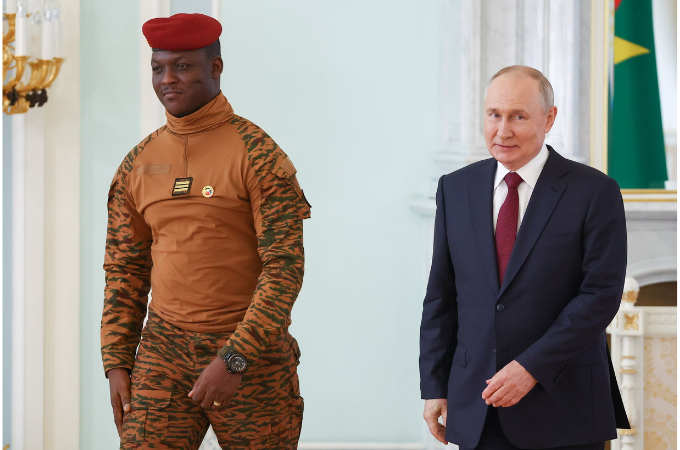
Burkina Faso Formally Accedes to Vienna Convention, Securing Legal Framework for Nuclear Energy
Burkina Faso has taken a major step toward realizing its civilian nuclear energy ambitions with the unanimous approval by the Transitional Legislative Assembly on January 27, 2026, of the country’s accession to the Vienna Convention on Civil Liability for Nuclear Damage (1963).
The decision, formalized and entering into effect around January 28, 2026, establishes a robust international legal framework that ensures operator liability for nuclear incidents, enables victims to claim compensation without proving fault, and channels primary responsibility to the nuclear facility operator.
At a Glance: Nuclear Strategy & Impact
-
Energy Access: Currently only 20–25% of the population has reliable electricity.
-
The Goal: Triple electricity production capacity by 2030 through nuclear power.
-
Key Partner: Rosatom (Russia’s state nuclear corporation).
-
Legal Milestone: Accession to the Vienna Convention establishes strict liability and global safety norms.
Background on Burkina Faso’s Nuclear Push
This accession is a critical component of Burkina Faso’s broader strategy to address chronic electricity shortages—where only about 20–25% of the population has reliable access—and to support economic development, industrialization, and quality of life under the leadership of President Ibrahim Traoré. The country has faced persistent power deficits, relying heavily on imported electricity (from Côte d’Ivoire and Ghana) and expensive fossil fuels, which constrain mining operations, agro-processing, and household access.
The move builds directly on deepening cooperation with Russia:
-
October 2024: Rosatom and Burkina Faso signed a memorandum of understanding (MoU) to explore establishing a nuclear power facility.
-
June 19, 2025: A comprehensive intergovernmental agreement on cooperation in the peaceful use of nuclear energy was signed during the St. Petersburg International Economic Forum.
-
Ambition: Discussions centered on small modular reactors (SMRs) with a goal to have a plant operational by 2030.
-
IAEA Involvement: The International Atomic Energy Agency (IAEA) provided support via a legislative assistance workshop in October 2025.
Why the Vienna Convention Matters
Joining the Vienna Convention aligns Burkina Faso with international nuclear safety and liability norms, making the country more attractive to foreign partners like Rosatom while demonstrating commitment to responsible development. Adopted in 1963 and amended in 1997, the Vienna Convention establishes:
-
Strict liability for nuclear operators—no need for victims to prove negligence.
-
Exclusive liability channeled to the operator of the nuclear installation.
-
Minimum liability amounts and mandatory insurance or financial security.
-
A unified system for compensation claims, including transboundary incidents.
Strategic & Geopolitical Context
Burkina Faso’s nuclear ambitions reflect a broader pivot under the Alliance of Sahel States (AES)—comprising Mali, Burkina Faso, and Niger—toward diversified partnerships and reduced dependence on Western donors. The country has deepened ties with Russia across defense, energy, and infrastructure since the 2022 military transition.
Reliable baseload electricity is essential for mining (gold is a major export) and agro-industrial processing. Nuclear energy offers a low-carbon alternative to expensive diesel generators, supporting climate resilience in a region vulnerable to drought.
Challenges and Comparative Perspectives
Despite the milestone, significant hurdles remain:
-
High upfront capital costs: Potential reliance on Russian loans.
-
Workforce development: Extensive training needs requiring IAEA and Russian assistance.
-
Grid upgrades: Infrastructure must be strengthened for large-scale output.
-
Security concerns: Jihadist threats in border regions complicate site selection.
Comparative African Experiences
| Country | Partner | Status (2026) |
| Egypt | Rosatom | Constructing El Dabaa plant (4 reactors). |
| Ghana | Rosatom/US | Exploring SMRs; Advanced IAEA milestones. |
| Rwanda | Rosatom | Training focus; Research center focus. |
| South Africa | Various | Operating Koeberg; Approving new 4 GW facility. |
Burkina Faso’s accession to the Vienna Convention positions it among Africa’s emerging nuclear aspirants. Early phases will focus on regulation, training, and site selection under IAEA oversight to ensure safety and nonproliferation.
