











![Hon. Festus Keyamo SAN arrives MMIA past 11:50 p.m. Feb 23 to lead oversight of Terminal 1 fire. Joined FAAN MD & team actively managing situation. Directed morning inspection Tuesday to guide restoration & confirm safety standards. Reaffirmed focus on passenger safety. Story: [link] #KeyamoMMIA #FireIncident #FAAN](https://fullcliphq.com/wp-content/uploads/2026/02/mym-150x150.jpg "MMIA Fire: Keyamo Inspects Lagos Airport After Terminal 1 Blaze Disrupts Flights")
































































































































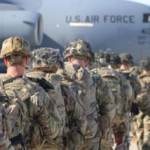


























































































































































































The United States has marked a major advancement in its nuclear energy revival with the successful airlift of an unfueled small modular reactor (SMR) prototype using military C-17 Globemaster III transport aircraft.
The operation, named Operation Windlord, moved the Ward250 reactor – developed by California – based startup Valar Atomics – from March Air Reserve Base in California to Hill Air Force Base in Utah on February 15, 2026.
From Hill AFB, the reactor components will be transported to the Utah San Rafael Energy Lab (USREL) in Orangeville for detailed testing and evaluation. The lift involved three C-17 aircraft carrying the eight modular sections of the reactor, demonstrating the feasibility of rapid, long-distance deployment of nuclear hardware.
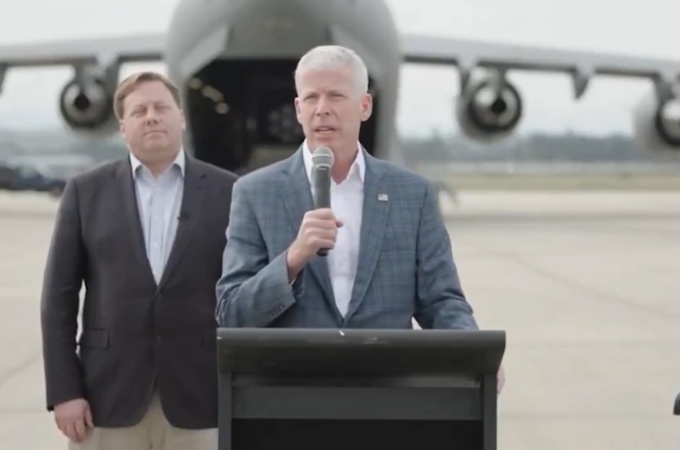
Energy Secretary Chris Wright joined the flight alongside senior officials, including Undersecretary of War for Acquisition and Sustainment Michael Duffey, Utah Governor Spencer Cox, Valar Atomics CEO Isaiah Taylor, Senator John Curtis, and U.S. Chief Technology Officer Ethan Klein. A press conference followed the arrival at Hill AFB, broadcast live through official channels.
Ward250 Reactor Specifications
The Ward250 is a high-temperature gas-cooled reactor (HTGR) design that builds on proven technologies for enhanced safety and efficiency:
-
TRISO fuel particles: Uranium kernels coated in multiple ceramic layers provide exceptional heat resistance and containment of radioactive material, greatly reducing meltdown risk.
-
Helium coolant: Circulates through the core, enabling high operating temperatures (up to 750–950°C) for improved thermal efficiency and potential industrial heat applications.
-
Graphite moderator: Slows neutrons to sustain the chain reaction while maintaining structural stability under extreme conditions.
-
Modular construction: Allows factory fabrication of components, reducing on-site build time, costs, and construction risks compared to traditional large-scale reactors.
The unfueled state during transport ensured complete safety compliance, with no nuclear material present on board.
Link to National Priorities
The airlift directly supports President Donald Trump’s Executive Order 14301 (May 2025), which streamlined nuclear reactor testing at the Department of Energy and launched the Nuclear Reactor Pilot Program. That program selected 11 advanced reactor designs with an aggressive target: achieve criticality (sustained nuclear chain reaction producing power) in at least three new designs on U.S. soil by July 4, 2026.
Valar Atomics is among the leading contenders. Delivery to USREL positions the Ward250 for rigorous testing, helping the U.S. regain leadership in advanced nuclear technology amid competition from China and Russia, which are rapidly expanding next-generation reactor programs.
Reactions and Strategic Significance
Supporters hailed the airlift as a breakthrough for U.S. energy independence and technological superiority. One defense analyst described it as a “doctrine shift,” where portable nuclear capability becomes a strategic asset for resilience under pressure.
Beyond civilian energy, the project has clear military applications. Compact, reliable nuclear power sources could provide resilient electricity to remote bases or forward operating locations, reducing dependence on vulnerable fuel convoys. Utah’s role highlights the state’s emergence as a hub for energy innovation, with Governor Cox championing nuclear power as part of a strategy to power the 2034 Winter Olympics.
Success in meeting the July 4, 2026, criticality goal would signal a rapid acceleration in the U.S. nuclear renaissance — delivering clean, reliable energy at a pace not seen in decades.