
Tehran Residents Face 4-Hour Lockdown as IDF Signals Strikes on Western District
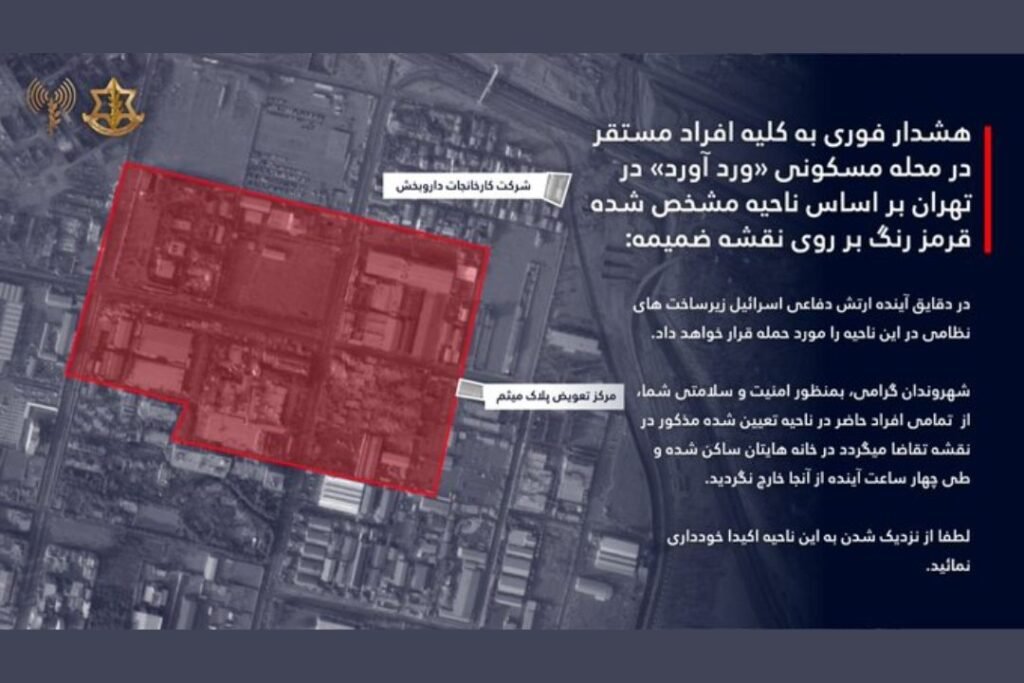
The Israel Defense Forces has issued a direct public warning this morning to residents of the Vard Avarad residential neighborhood in western Tehran, urging them to remain indoors for four hours as Israeli forces prepared to target nearby military infrastructure.
The alert, posted in Persian on the IDF’s official Farsi-language X account (@IDFFarsi
), included a satellite image marking a red-zoned area and stressed the intention to minimize civilian harm. It read: “Urgent warning to all individuals located in the Vard Avarad residential neighborhood in Tehran… In the coming minutes, the Israel Defense Forces will target military infrastructure in this area. For your safety, all individuals in the specified area are requested to stay inside their homes and not leave for the next four hours.”
This type of humanitarian-style notification is one of several issued by the IDF in recent weeks amid the ongoing U.S.-Israeli military campaign against Iran, now in its second month. The conflict began with surprise airstrikes on February 28, 2026, that reportedly killed Supreme Leader Ali Khamenei and senior regime figures, and has since focused on degrading Iran’s ballistic missile capabilities, air defenses, nuclear-related sites, and security apparatus.
Israeli officials report that more than 600 facilities linked to Iran’s missile production and storage have been struck since operations intensified around March 24. Key targets have included complexes such as Khojir, Parchin, Hakimiyeh, and Shahroud, where satellite imagery shows significant damage to buildings involved in missile component manufacturing, warhead production, and launch infrastructure. The campaign aims to disrupt Iran’s ability to regenerate large-scale missile barrages.
Iran has continued limited retaliatory attacks, launching roughly 10 missiles or drones per day in some periods toward Israeli territory, with some causing damage and injuries. However, its capabilities appear substantially weakened due to the destruction of production sites, storage facilities, and launchers. In addition, involvement from Iranian-backed proxies, including the Houthis, has added to regional tensions.
The warning for Vard Avarad highlights the challenges of urban warfare in a heavily censored environment. Iran has maintained a near-total internet blackout for over 30 days, with connectivity dropping to about 1% of normal levels. This government-imposed restriction has severely limited the alert’s reach inside the country, leaving many residents potentially unaware or unable to receive real-time information.
Iranian users on social media, particularly in the diaspora, responded to the IDF post by praising the intent to protect civilians while urging satellite television channels such as Iran International and Manoto to broadcast the warning. Hashtags like #DigitalBlackOutIran trended as opposition voices called for external assistance to bypass the blackout and prevent unintended casualties.
The regime has a history of using internet shutdowns during periods of crisis to control information flow and suppress dissent. In the current conflict, these measures have further isolated families and complicated efforts to verify on-the-ground impacts of strikes.
Broader Israeli operations have also targeted regime security nodes in Tehran, including Basij and IRGC facilities reportedly used for internal repression, as well as sites linked to nuclear infrastructure such as the Arak heavy water plant. Power outages and infrastructure damage have also been reported in parts of the capital.
Diplomatic signals from the United States regarding possible pauses tied to negotiations remain uncertain amid ongoing military activity.
For ordinary Iranians, the combination of airstrikes, prolonged blackouts, and restricted information has created significant hardship and uncertainty. Many express hope that military capabilities linked to the regime can be neutralized without widespread civilian suffering, while opposition figures call for greater international support toward political change.
