
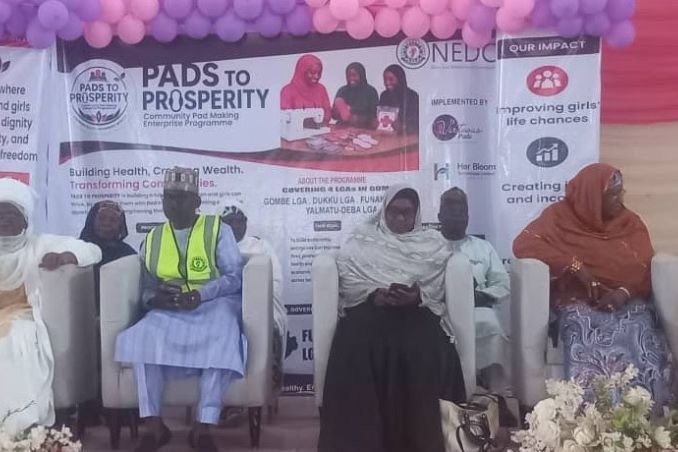
NEDC Trains Women on Pad Production
Nigeria’s North-East Development Commission has begun a pilot training programme for 280 women and girls in Gombe State on the production of reusable sanitary pads, aiming to improve menstrual hygiene and create income-generating opportunities in communities affected by years of insecurity and underdevelopment.
The initiative, titled “Pads to Prosperity,” is being rolled out across four local government areas – Gombe, Dukku, Funakaye and Yamaltu Deba, with 70 participants selected from each. Speaking at the launch of the training, Gombe State Coordinator of the NEDC, Usman Muhammad, said the programme was designed to equip participants with practical skills to manufacture sanitary pads using locally available materials. He described the project as part of the Commission’s broader commitment to empowering women and raising living standards across the North-East.
Dr Constance Ikosomi, Head of the Youth and Women Empowerment Unit at the NEDC, noted that the skills acquired could translate into sustainable livelihoods. Participants will receive instruction not only in production but also in packaging and marketing, enabling them to establish small enterprises once the training concludes.
Project Implementation Lead and Chief Executive Officer of Virtuous Reusable Sanitary Pads, Tabitha Abimuke, highlighted an additional benefit: reducing school absenteeism among girls who currently miss classes during menstruation because of limited access to affordable sanitary products. The knowledge gained, she said, would allow beneficiaries to support both their own economic independence and improved menstrual hygiene within their communities.
As the training proceeds, organisers expect the combination of technical instruction and market-oriented guidance to give participants a foundation for small-scale businesses. Success in Gombe could inform future expansion of the programme to other parts of the North-East, where access to affordable menstrual products and economic opportunities for women and girls remain pressing concerns.
