
“We Are Going to War”: Niger’s Junta Calls for General Mobilization Against France
A senior officer in Niger Republic’s ruling junta has openly declared that the country must prepare for direct armed conflict with France, accusing Paris of masterminding efforts to undermine national stability and deliberately worsening insecurity through covert backing of extremist groups.
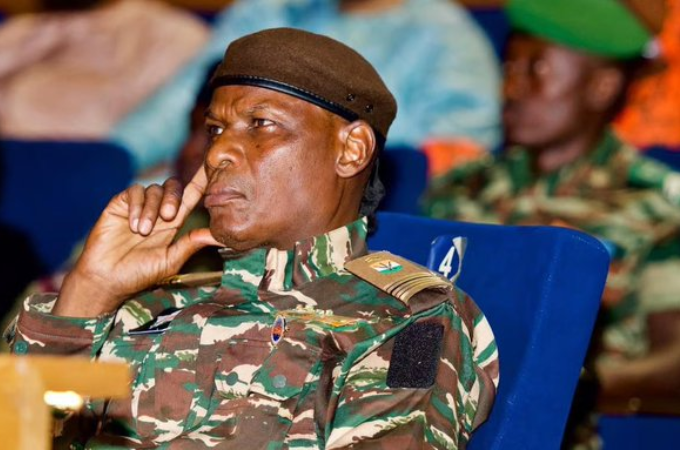
General Amadou Ibro, chief military adviser to junta leader General Abdourahamane Tiani, delivered the stark message during a public address on Thursday, February 13, 2026. He framed France as an active enemy intent on destabilizing Niger, linking the alleged threat to persistent jihadist violence and recent high-profile attacks.
The warning follows a nationwide mobilization order issued on December 26, 2025, which called on citizens to ready themselves to resist armed insurgents, particularly factions of Islamic State Sahel Province (ISSP) and Jama’at Nasr al-Islam wal Muslimin (JNIM). General Ibro specifically pointed to the January 29, 2026, attack on Niamey’s Diori Hamani International Airport as proof of French involvement.
Niamey Airport Attack – January 29, 2026
Militants launched a coordinated assault on the capital’s main airport, one of the most fortified sites in the country. The attackers used gunfire, explosives, and attempted perimeter breaches, killing several security personnel and civilians while damaging aircraft hangars and support infrastructure. Operations were temporarily disrupted.
The junta immediately blamed France and certain neighboring governments, claiming the raid was engineered to weaken Tiani’s authority and punish Niger for expelling French forces in 2023. France rejected the allegations outright, calling them fabricated propaganda and emphasizing that all French troops (including remnants of Operation Barkhane) had left Niger completely by late 2023.
Jihadist Threats in the Sahel – Ongoing Crisis
The Sahel – spanning Mali, Burkina Faso, Niger, Chad, and Mauritania – has become one of the world’s most violent regions since 2012, when Islamist fighters exploited Libya’s collapse to spread southward. JNIM (al-Qaeda-linked) and ISSP (Islamic State affiliate) lead the insurgency, carrying out ambushes, suicide bombings, massacres in villages, abductions, and assaults on military bases.
In Niger, violence concentrates along the Mali and Burkina Faso borders (Liptako-Gourma area). Recent years have seen:
-
Hundreds of soldiers and civilians killed in roadside bombs, outpost attacks, and village raids.
-
Tillabéri, Diffa, and Tahoua regions most affected.
-
ISSP frequently claiming responsibility for complex operations using IEDs, vehicle bombs, and motorcycle-mounted fighters.
-
Over 500,000 people internally displaced in Niger alone, with many fleeing to cities or crossing into neighboring countries.
Since 2023, the junta has relied heavily on Russian assistance – including Africa Corps (formerly Wagner) trainers, weapons, and advisors – to replace earlier French and U.S. support. While this has yielded some localized gains, violence has not significantly declined overall, and the regime has faced criticism for heavy-handed tactics against critics, journalists, and civil society.
France insists it no longer maintains any military presence in Niger and has shifted to diplomatic engagement and humanitarian aid for Sahel partners. Paris has repeatedly dismissed accusations of supporting jihadists or orchestrating attacks as deliberate disinformation designed to justify the junta’s alignment with Russia.
General Ibro’s declaration reflects the junta’s recurring narrative of external sabotage, often used to rally domestic support and legitimize internal controls. With jihadist groups maintaining pressure and regional alliances in flux, the Sahel remains a deeply unstable zone, and the threat of direct confrontation – even if rhetorical – adds another layer of tension to an already volatile landscape.
