










































![Hon. Festus Keyamo SAN arrives MMIA past 11:50 p.m. Feb 23 to lead oversight of Terminal 1 fire. Joined FAAN MD & team actively managing situation. Directed morning inspection Tuesday to guide restoration & confirm safety standards. Reaffirmed focus on passenger safety. Story: [link] #KeyamoMMIA #FireIncident #FAAN](https://fullcliphq.com/wp-content/uploads/2026/02/mym-150x150.jpg "MMIA Fire: Keyamo Inspects Lagos Airport After Terminal 1 Blaze Disrupts Flights")



































































































































































































































































The Nigerian Electricity Regulatory Commission (NERC) has issued Order NERC/2026/025, effective March 1, 2026, mandating electricity distribution companies (DisCos) to fully automate the reimbursement of meter costs paid by customers under the Meter Asset Provider (MAP) framework.
The directive aims to clear an outstanding N20.33 billion owed as of December 31, 2025, through accelerated recovery over the next 12 months.
The order amends the 2023 reimbursement framework and is issued under Section 226 of the Electricity Act 2023, which empowers NERC to make regulations necessary for implementing the Meter Asset Provider and National Mass Metering Regulations 2021. It follows a February 2026 compliance review that confirmed persistent delays in refunds, widespread customer complaints, and mounting dissatisfaction with the slow pace of repayment.
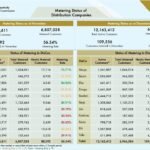
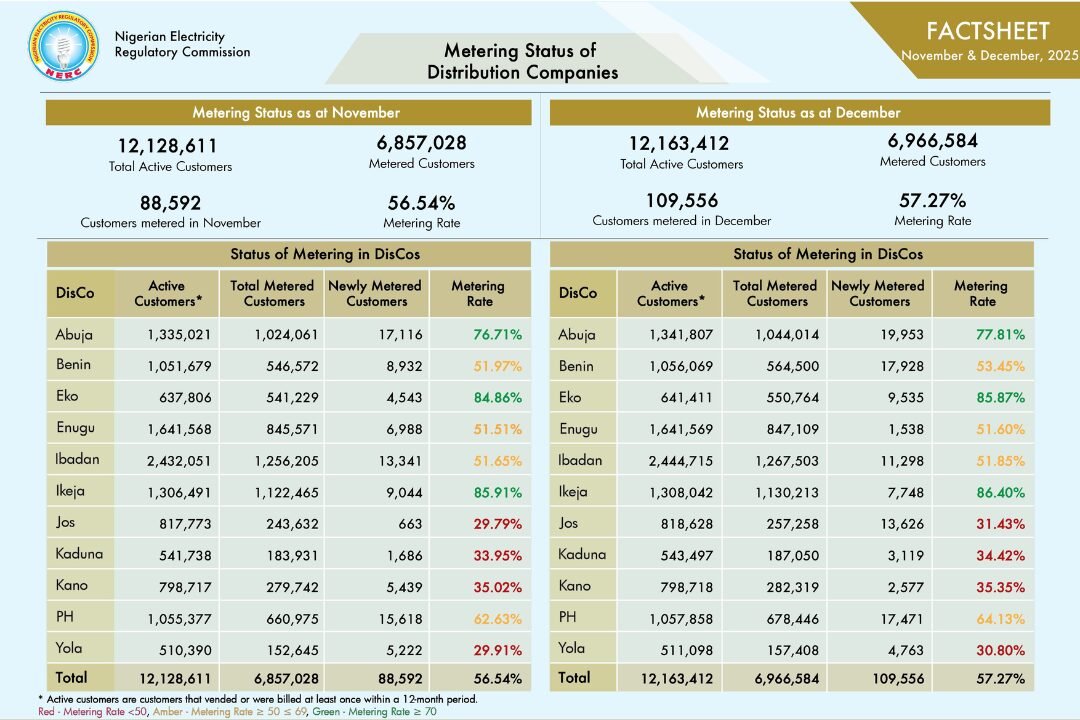
Under the MAP scheme, customers pay upfront for prepaid meters supplied by third-party providers, with DisCos expected to refund the cost through energy credits over an amortisation period (typically 120 months). However, implementation has been inconsistent since the programme’s rollout in 2021. As of November 2025, only 56.54% of Nigeria’s 12,128,611 active customers were metered (6,857,028 metered), with 88,592 new customers metered that month. By December 2025, the metering rate rose marginally to 57.27% (6,966,584 metered out of 12,163,412 active customers), with 109,556 new meters added.
DisCo-level data reveals stark disparities. Ikeja Electric led with 85.91% metering in November (rising to 86.40% in December), while Jos, Yola, and Kaduna lagged significantly below 35%. The slow pace of metering and even slower reimbursement have compounded customer frustration, especially in a sector where estimated billing remains widespread.
The new order requires DisCos to recognise the full cost of each MAP meter as a credit on the customer’s account upon activation. Credits must be disbursed automatically as monthly instalments over the amortisation period. For prepaid customers, DisCos must generate monthly energy tokens (equivalent to the reimbursement value) no later than the fourth day of each month. Postpaid customers must receive the reimbursement as a distinct credit line item deducted from their monthly bill.
To recover the N20.33 billion arrears, DisCos are required to accelerate repayment over 12 months starting March 1, 2026. During this period, prepaid customers will receive two tokens per month, and postpaid customers will see two reimbursement line items on their bills. Crucially, NERC prohibits DisCos from offsetting meter reimbursement credits against legacy debts—both must be treated separately.
NERC has also mandated monthly compliance reporting using an approved template, detailing the total value of reimbursements disbursed. DisCos must establish dedicated email addresses for receiving and resolving customer complaints related to non-reimbursement, with complaint status included in monthly submissions.
The MAP programme was launched to accelerate nationwide metering and reduce estimated billing, which has long fuelled disputes over inflated charges. Despite progress – metering rose from roughly 40% in 2021 to over 57% by late 2025 – reimbursement delays have undermined trust. Past efforts to enforce timely refunds, including the 2023 order, yielded limited results, prompting repeated complaints and regulatory warnings.
The latest directive reflects NERC’s determination to close implementation gaps, restore customer confidence, and strengthen the credibility of the metering value chain. However, the persistent low metering rates in several DisCos (e.g., Jos at 31.43%, Yola at 30.80%, Kaduna at 34.42% in December 2025) highlight systemic challenges, including funding constraints, logistical bottlenecks, and resistance to full transition from estimated billing.
The NERC order represents a targeted intervention in one segment of the sector – metering and customer refunds – but broader reforms are still needed to address generation, transmission, and distribution capacity if reliable grid electricity is to become a reality for most Nigerians.