
Niger’s Military Leader Appears in Public After Overnight Airport Attack
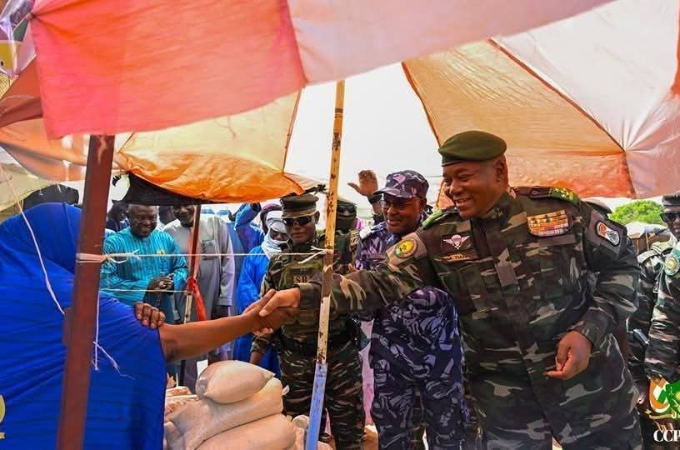
Thousands of supporters gathered in Niamey’s Place de la Conception on Thursday, January 29, 2026, in a large public rally led by General Abdourahamane Tchiani, head of Niger’s military junta, one day after a dramatic overnight security incident near Diori Hamani International Airport and Air Base 101.
The rally served as a powerful show of national unity and defiance following the early-morning assault that began shortly after midnight on January 29. Sustained heavy gunfire, tracer rounds, and powerful explosions were reported for one to two hours before Nigerien security forces restored calm. Authorities described the event as a foiled “terrorist attack” or destabilization attempt, with some pro-junta voices alleging an effort to seize or disrupt a strategic stockpile of uranium yellowcake stored at the site.
Satellite imagery analyzed by independent observers showed visible damage to several buildings on the military side of the airport complex, including structures potentially linked to storage or logistics. Reports indicate civilian aircraft on the tarmac, including planes operated by Asky Airlines and Air Côte d’Ivoire, sustained bullet damage to fuselages, though no major structural harm to passenger terminals was confirmed.
Nigerien officials stated that the uranium shipment—estimated at around 1,000 metric tons and relocated from the northern Somair mine late last year—remained secure and unaffected. The cargo, now under full state control following the junta’s nationalization of French-operated uranium assets in June 2025, has been at the center of an escalating diplomatic and legal standoff with France. Orano (formerly Areva), the French state-linked nuclear firm that previously held a 63.4% stake in Somair, has pursued international arbitration through the International Centre for Settlement of Investment Disputes (ICSID), securing interim rulings barring Niger from selling pre-nationalization stockpiles. France’s financial prosecutor launched a criminal investigation in late 2025 into alleged organized theft of uranium valued at hundreds of millions of dollars.
The Presidential Address and Military Response
In a televised address following an on-site inspection of the air base, General Tchiani directly accused French President Emmanuel Macron, Benin’s Patrice Talon, and Côte d’Ivoire’s Alassane Ouattara of sponsoring the attackers—allegations presented without supporting evidence. He vowed that Niger would shift from a defensive posture to an “offensive” stance if provocations continued, while extending thanks to “Russian partners” for their role in repelling the incursion.
Niger’s defense ministry reported that security forces neutralized over 20 assailants, including one alleged French national, and detained more than a dozen suspects. The army described the response as “surgical” and effective, emphasizing coordination between the Nigerien Armed Forces (FAN) and allied elements.
The rally drew large crowds waving Nigerien flags and chanting in support of the transitional government. Videos and images showed General Tchiani addressing the gathering amid heavy security, with several high-ranking officials in attendance. Pro-junta accounts on social media portrayed the demonstration as proof of unbreakable public resolve against “imperialist” interference and internal sabotage.
While normal life resumed in much of Niamey—with businesses and schools operating—security remained tight around the airport zone, now heavily patrolled. No independent casualty figures from the attackers’ side have been verified, and international reactions have so far been muted, with France, Benin, and Côte d’Ivoire yet to respond formally to the accusations.
Resource Dispute & Geopolitical Stakes
The attack unfolded against the backdrop of a prolonged resource dispute that intensified in 2025. In June of that year, the junta nationalized the Somair uranium mine, previously majority-controlled by Orano. Niger maintains the nationalization and subsequent export plans represent a legitimate exercise of sovereignty over national resources. The junta has accused Orano of environmental violations, including leaving radioactive waste at former sites, and has pivoted toward alternative partnerships, including reported interest from Russian entities in uranium procurement.
Ongoing Instability in the Sahel
Niger has been under military rule since the July 2023 coup that ousted elected President Mohamed Bazoum. The country faces ongoing jihadist insurgencies by groups affiliated with Islamic State (IS-Sahel) and JNIM (Al-Qaeda-linked) in the Tillabéri, Diffa, and Tahoua regions. The capital has seen sporadic violence, including attempted protests and alleged coup-related incidents in 2023–2024, but a direct incident at the international airport represents a notable escalation if confirmed as an external attack.
The events of January 28–29—and the subsequent public show of strength—reinforce a narrative of resistance and resource control in the face of external pressures. The situation remains fluid, with potential for further diplomatic fallout, military escalation, or renewed international mediation efforts.
