
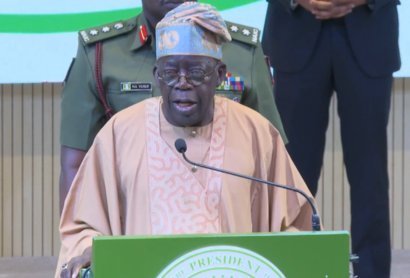
President Tinubu Commissions New Nigeria Revenue Service Headquarters in Abuja
President Bola Ahmed Tinubu has officially commissioned the new Corporate Headquarters of the Nigeria Revenue Service (NRS) in the Central Business District of Abuja, describing the facility as a significant milestone in the Federal Government’s comprehensive tax and fiscal reform agenda.
The impressive building, often referred to as “Revenue House,” consists of three interconnected towers spanning 16 floors and is designed to accommodate up to 3,000 staff members.
The project was first conceptualised and approved more than two decades ago, but construction gained momentum and reached completion under the current administration. The commissioning ceremony, broadcast live via YouTube and other paid media, was attended by senior government officials including Senate President Godswill Akpabio, Deputy Senate President Jibrin Barau, Speaker of the House of Representatives Tajudeen Abbas, and Deputy Speaker Benjamin Kalu.
President Tinubu personally unveiled a commemorative plaque at the site, formally inaugurating the building as the operational hub for Nigeria’s reformed revenue administration. The Nigeria Revenue Service officially replaced the Federal Inland Revenue Service (FIRS) following the signing of the Nigeria Revenue Service (Establishment) Act, 2025 by President Tinubu in June 2025.
The rebranding took full effect on January 1, 2026, as part of a broader set of landmark tax reform laws aimed at modernising Nigeria’s fiscal framework. Unlike its predecessor, which focused mainly on federal taxes, the NRS now serves as a centralised body responsible for the assessment, collection, and accounting of revenues accruable to the Federation as a whole.
This expanded mandate is intended to reduce duplication, minimise leakages, enhance transparency, and improve overall efficiency in revenue generation. The agency has also adopted a new logo and corporate identity to reflect its broader, service-oriented role.
Executive Chairman of the NRS, Dr. Zacch Adedeji, has played a key role in both completing the headquarters and driving the implementation of the reforms. Under his leadership, the agency has set ambitious revenue targets, including ₦40.71 trillion for the 2026 fiscal year – a substantial increase from previous benchmarks – covering taxes, royalties, and other streams.
The new headquarters symbolises the Tinubu administration’s commitment to institutional strengthening and policy continuity in economic governance. It provides state-of-the-art facilities to support digital tax administration, data analytics, and improved taxpayer services – key pillars of the ongoing reforms designed to broaden the tax base, simplify compliance, and foster sustainable non-oil revenue growth.
The long gestation period of the project, spanning more than two decades, highlights the challenges often faced in delivering major public infrastructure in Nigeria. Its timely completion and commissioning, however, underscore the current government’s focus on delivering critical assets for national development.
Observers view the move as part of a larger push to reduce reliance on oil revenues and ways-and-means financing, while strengthening fiscal institutions. Complementary measures, such as the Executive Order on direct remittance of oil and gas revenues into the Federation Account and retrospective audits of past collections, further reinforce this direction.
With the NRS now operating from its permanent, purpose-built headquarters, expectations are high for enhanced performance in revenue mobilisation. The agency is expected to play a pivotal role in funding national priorities, supporting sub-national governments through improved federation allocations, and contributing to macroeconomic stability.
