
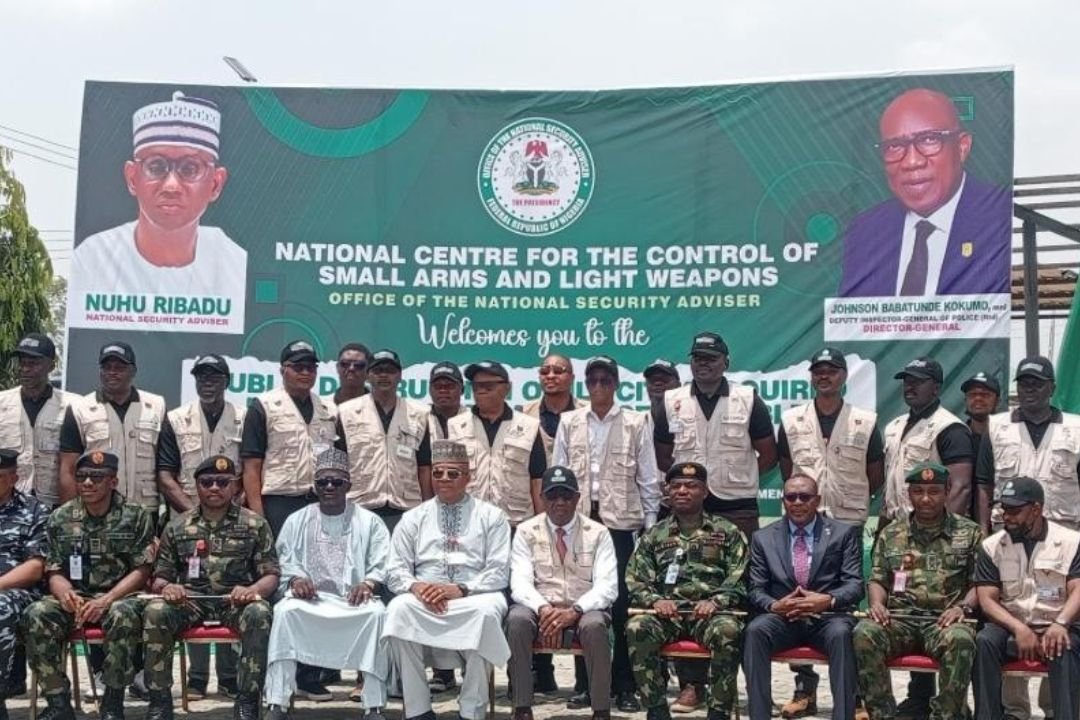
National Centre for Small Arms Destroys 2,800 Weapons as Nigeria Intensifies Fight Against Proliferation
Nigeria has carried out a significant national exercise to destroy 2,800 illicit and decommissioned weapons, reinforcing its commitment to combating the proliferation of small arms and light weapons that continue to fuel insecurity across the country.
The destruction took place on Friday, March 27, 2026, at the Muhammadu Buhari Cantonment in Giri, Abuja, under the coordination of the National Centre for the Control of Small Arms and Light Weapons. This marks the fifth major disposal operation since the Centre was established and brings the total number of weapons permanently removed from circulation to over 16,000 in the past four years.
The The Small Arms Survey (2026) – an independent, global research platform, estimates a range of 6 million to 6.5 million units of civilian-held firearms in Nigeria (legal and illegal combined).
Speaking on behalf of the National Security Adviser, Nuhu Ribadu, the Director of Defence Affairs at the Office of the National Security Adviser, Major General Hillary Mabeokwu, described the exercise as a deliberate strategic intervention against a persistent threat. He warned that the unchecked spread of small arms remains a primary driver of terrorism, banditry, violent crime, and general instability, not only in Nigeria but across the sub-Saharan region.
The Director-General of the National Centre for the Control of Small Arms and Light Weapons, Johnson Kokumo, explained that the weapons destroyed included decommissioned items from police stockpiles as well as illicit arms recovered during various security operations nationwide. The destruction process – involving burning and melting – ensures that the weapons cannot be diverted back into criminal hands.
Kokumo identified the main sources of illicit arms in Nigeria as cross-border trafficking, local artisanal manufacturing, and leakage from legitimate government stockpiles. He said current interventions are structured to address each of these pathways through improved enforcement, institutional reforms, and inter-agency coordination.
This latest destruction exercise reflects a shift from episodic seizures to systematic, transparent disposal and accountability. By publicly destroying recovered weapons, the government aims to send a clear signal that such arms will not be tolerated and will not re-enter circulation.
The initiative also supports Nigeria’s compliance with international arms control obligations and strengthens the evidentiary chain required for effective prosecution of arms-related offences. It forms part of a broader national strategy to close loopholes that allow illicit weapons to sustain violence and undermine development efforts.
Authorities emphasised that sustained progress will require continued collaboration between security agencies, regional partners, and international organisations to improve tracing, marking, and management of legitimate firearms while aggressively targeting illicit ones.
Comparative Perspective on Arms Control in Africa
Across Africa, arms control efforts remain uneven despite the existence of regional frameworks such as the Nairobi Protocol for the Prevention, Control and Reduction of Small Arms and Light Weapons in the Great Lakes Region and the Horn of Africa, and the ECOWAS Convention on Small Arms and Light Weapons.
While countries like Ghana, Senegal, and Rwanda have made notable progress in stockpile management, marking, and destruction programmes, many others struggle with weak institutional capacity, porous borders, and limited resources for implementation.
Nigeria’s regular public destruction exercises stand out as a relatively transparent model, but challenges persist due to the scale of artisanal production and cross-border trafficking from conflict zones in the Sahel and Lake Chad Basin.
At the continental level, the African Union’s Silencing the Guns initiative and the African Commission on Small Arms have pushed for harmonised legislation and better information-sharing among member states. However, enforcement often lags behind policy commitments.
Locally, Nigeria’s Firearms Act and the establishment of the National Centre for the Control of Small Arms represent important domestic legislation, yet gaps remain in regulating craft production and ensuring consistent inter-agency coordination.
