
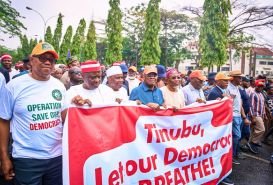
Opposition Leaders Stage #OccupyINEC Protest in Abuja, Demand Recognition of ADC Leadership
Prominent Nigerian opposition figures, including former Vice President Atiku Abubakar, Labour Party’s 2023 presidential candidate Peter Obi, former Kano State Governor Rabiu Kwankwaso, former Senate President David Mark, former Governor Rotimi Amaechi and others, led a large peaceful protest in Abuja today demanding that the Independent National Electoral Commission recognise the leadership of the African Democratic Congress.
The demonstration, tagged #OccupyINEC and described by organisers as a “Save Democracy” march, saw hundreds of supporters converge at Maitama Roundabout before proceeding towards the INEC headquarters. Protesters chanted slogans, sang the national anthem and carried banners calling for the protection of democratic space ahead of the 2027 general elections.
The immediate trigger for the protest was INEC’s decision to suspend recognition of correspondence from the ‘faction’ of the African Democratic Congress led by Senator David Mark as National Chairman and Rauf Aregbesola as National Secretary. The commission cited a Court of Appeal judgment and the need to maintain the status quo pending final resolution of the party’s long-running internal leadership dispute.
Opposition leaders argue that the move amounts to partisan interference aimed at weakening viable opposition platforms and potentially paving the way for one-party dominance. David Mark and his supporters accuse INEC of bias and have called for the resignation of INEC Chairman Professor Joash Amupitan and the national commissioners.
At the march, Peter Obi told the crowd that Nigerians who believe in democracy must rise to defend it, stating that the country must not slide into a one-party system. Atiku Abubakar warned against the enthronement of dictatorship, while Rotimi Amaechi and other speakers linked the protest to broader concerns about economic hardship and shrinking democratic space.
The protest remained largely peaceful, with participants emphasising non-violent civic action. Video footage shared on social media showed coordinated groups marching through Abuja streets, highlighting the level of organisation. The ADC Youth Wing had earlier issued a 72-hour ultimatum to INEC to reverse its decision or face further nationwide action.
INEC has maintained that it is not taking sides in the internal party matter but is simply complying with court orders. The commission has stressed that leadership disputes within political parties are internal affairs that should ultimately be resolved by the courts.
Meanwhile, a counter-protest supporting INEC’s position has been reported in previous days, indicating divided opinions even within a deeply pro establishment civil society. The demonstration represents a notable moment of cross-party collaboration, with figures associated with the Peoples Democratic Party, Labour Party and other groups coming together in solidarity with the ADC faction.
Informed observers view the protest as an early indication of potential opposition realignment or coalition-building efforts ahead of the 2027 elections, especially amid public discontent over economic conditions. The African Democratic Congress has been embroiled in factional disputes for several months, with competing claims to control of the party structure.
A newer group of state chairmen yesterday rejected both major factions and expressed support for INEC’s handling of the matter in some instances.
Nigeria has seen similar opposition protests directed at INEC in the past, including during the period when the current ruling party was in opposition. Today’s event has revived debates about the independence of electoral institutions, the role of the judiciary in party affairs and the overall health of the country’s democracy nearly three decades after the return to civilian rule.
As the 2027 election cycle approaches, the standoff has raised questions about the credibility of the electoral process. Opposition figures have warned that failure to resolve the issue could dangerously shrink the democratic space, while government and INEC officials insist that adherence to due process and judicial oversight is necessary to prevent chaos.
The protest occurred against the backdrop of ongoing economic pressures, including high inflation, fuel and electricity challenges, which have contributed to public frustration. Many participants linked these governance issues to the need for stronger and more credible opposition parties.
Organisers have indicated that further actions may be taken if their demands are not met. Legal proceedings concerning the ADC leadership dispute are expected to continue, with both sides likely to intensify efforts in the courts.
