
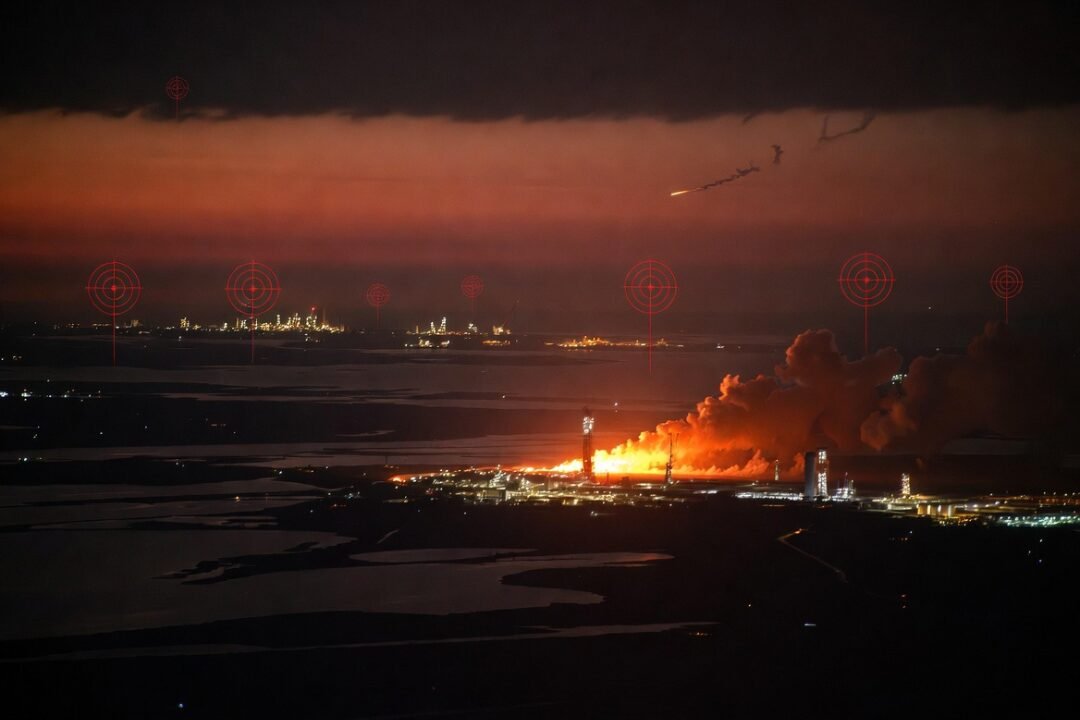
IRGC Issues Evacuation Warnings for Major Energy Sites in Saudi Arabia, UAE and Qatar
Iran’s Islamic Revolutionary Guard Corps (IRGC) has issued urgent evacuation warnings for several major energy infrastructure sites in Saudi Arabia, the United Arab Emirates and Qatar, raising fears of a dangerous new phase in the widening regional conflict.
The move came hours after reports of coordinated U.S.-Israeli strikes on Iran’s portion of the giant South Pars natural gas field, one of the world’s most important energy assets.
In statements carried by Iranian state and semi-official media, including Tasnim News Agency, the IRGC described specific facilities in the three Gulf Arab states as “direct and legitimate targets” for retaliation. It warned that strikes could occur “within the coming hours” and urged immediate evacuation of personnel and civilians from the listed sites.
The targeted facilities include:
- In Saudi Arabia: the SAMREF refinery, Jubail petrochemical complex, and Sadara petrochemical complex.
- In the UAE: the Al Hosn (Shah) gas field.
- In Qatar: the Mesaieed petrochemical complex, Ras Laffan refinery and LNG installations – a global hub for liquefied natural gas exports.
Personnel at Ras Laffan and several Saudi Aramco-linked sites have reportedly begun evacuating. Iranian media framed the warnings as a proportionate response to the attack on Iranian energy infrastructure.
The reported strike on South Pars/Asaluyeh in Bushehr province marks the first confirmed targeting of Iran’s upstream oil and gas sector since the broader conflict intensified. South Pars, the world’s largest natural gas field, is shared with Qatar (where it is known as the North Field) and accounts for a substantial share of Iran’s domestic gas supply, electricity generation and export potential. Qatar’s foreign ministry condemned the strike on facilities linked to South Pars, calling it a “dangerous and irresponsible step.”
This latest escalation risks turning the conflict into a full-scale “energy war.”
Informed observers warn that any successful Iranian strikes on the named Gulf facilities could trigger severe supply shocks. Ras Laffan and South Pars together represent a huge portion of global LNG capacity, while Saudi and UAE refineries and petrochemical plants are vital to regional exports and domestic fuel supply.
Further disruption in the Persian Gulf could push crude oil prices significantly higher. Brent crude has already rebounded amid recent attacks, trading around or above $100 per barrel in volatile sessions, with some forecasts warning of spikes toward $150 – 200 if the Strait of Hormuz remains restricted for an extended period.
The war, now in its third week, has seen both sides increasingly target energy infrastructure. Iran has conducted missile and drone strikes on Gulf energy sites and sought to disrupt shipping through the Strait of Hormuz, through which roughly one-fifth of global oil trade normally flows. The waterway has become nearly impassable at times, forcing Gulf producers to curtail output and reroute tankers where possible.
No immediate casualties were confirmed from the South Pars strike in initial reports, and it remains unclear whether the IRGC warnings will lead to imminent attacks or serve primarily as deterrence and psychological pressure. Evacuation orders have nonetheless heightened security alerts across the Gulf.
This development underscores the growing risk that the conflict could have cascading effects on global commodity prices, supply chains and economic stability far beyond the Middle East.
