
US-Iran Nuclear Talks Collapse in Islamabad: Vance Declares “Final Offer” Rejected
The United States and Iran failed to reach an agreement during more than 21 hours of direct, high-level negotiations in Islamabad, dealing a setback to efforts to solidify a fragile two-week ceasefire.
US Vice President JD Vance announced the collapse, stating that Tehran had rejected Washington’s core demand for an explicit commitment to abandon any pursuit of nuclear weapons or the capabilities that could enable a rapid “breakout” to produce them.
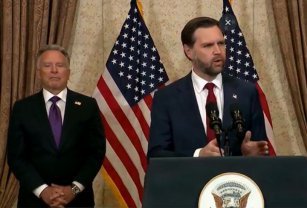
Vance made the remarks in a brief press conference captured on video and posted by the White House on X early Sunday morning local time. He stood at a podium flanked by American flags and said the US delegation had been “quite flexible” and “quite accommodating” under instructions from President Donald Trump, but Iran “chose not to accept our terms.” Vance described the US position as its “final and best offer” and said the ball was now in Tehran’s court.
The marathon session marked the first high-level, in-person negotiations between the United States and Iran in decades. Pakistan’s government acted as mediator and host, having helped broker the ceasefire announced around April 7.
Meanwhile, US naval vessels are actively patrolling and clearing key areas of the strait to facilitate safe transit for approved commercial shipping, particularly from friendly nations, while international shipping companies continue to reroute or delay voyages amid heightened insurance costs and security risks. Oil prices have shown renewed volatility in response, underscoring the waterway’s critical role in global energy flows, with roughly one-fifth of the world’s seaborne oil normally passing through it.
The truce paused open hostilities in a conflict that began on February 28, 2026, and has already caused thousands of deaths, disrupted global energy markets and raised fears of a wider regional war involving Israel, Hezbollah in Lebanon and threats to the Strait of Hormuz. The US delegation, which included special envoy Steve Witkoff and senior adviser Jared Kushner, met separately with Pakistani Prime Minister Shehbaz Sharif before engaging with the Iranian team led by Parliament Speaker Mohammad Bagher Qalibaf and Foreign Minister Abbas Araqchi.
Security in the Pakistani capital was tightened, and a two-day public holiday was declared to facilitate the talks.
However, Iranian officials and state media offered a different assessment. While acknowledging the intensity of the discussions, they described the US demands as excessive and said “some progress” had been made on secondary issues.
Tehran insisted that no one expected a comprehensive agreement from a single round of talks and accused Washington of using the negotiations as a pretext to exit prematurely. The central sticking point remained Iran’s nuclear programme.
The United States and Israel have long argued that Tehran’s uranium enrichment activities, which have reached levels far beyond civilian needs, could enable a rapid dash to weapons-grade material. Iran maintains its programme is peaceful and denies any intention of building a bomb.
Vance’s statement echoed longstanding US policy under the Trump administration: verifiable, permanent restraints on enrichment, centrifuge development and related tools that could shorten Iran’s breakout timeline to weeks or days.
To understand the stakes, consider the history and technical realities. The 2015 Joint Comprehensive Plan of Action had limited Iran’s enrichment to 3.67 per cent uranium-235, capped stockpiles and imposed strict monitoring by the International Atomic Energy Agency. After the US withdrawal in 2018 and subsequent sanctions, Iran resumed higher-level enrichment, reportedly approaching 60 per cent or more in recent years, and installed advanced centrifuges.
Experts warn that today’s breakout time has shrunk dramatically compared with 2015 levels. A successful deal would have required Iran to roll back these advances in exchange for sanctions relief and security guarantees. Failure risks renewed escalation, including potential Israeli or US strikes on Iranian facilities, further Iranian proxy actions in Lebanon or the Gulf, and renewed threats to close the Strait of Hormuz.
The war’s economic ripples have already been felt worldwide. Energy prices spiked, shipping costs rose and inflation concerns resurfaced in multiple economies. A collapsed ceasefire could exacerbate these pressures and draw in additional actors. Social media and international observers reflected the divide.
Pro-regime-change voices among the Iranian diaspora celebrated the apparent hard line and called for maximum pressure on Tehran but critics of US policy pointed to the Trump administration’s 2018 withdrawal from the 2015 nuclear deal as the original catalyst for today’s impasse.
Pakistani officials are expected to continue quiet mediation efforts to preserve the truce. Vance boarded a plane back to the United States shortly after his remarks, leaving open the possibility that Iran could still accept the US offer during the remaining ceasefire window. White House officials have signalled that President Trump remains in close contact with the delegation and views the talks as part of a broader strategy to prevent Iran from ever acquiring nuclear weapons.
Whether the fragile truce holds or the region slides back into open conflict now depends on Tehran’s next move and Washington’s willingness to keep the diplomatic channel alive. For now, the simple fact Vance highlighted remains the unresolved crux of more than four decades of US-Iran estrangement: trust, verification and the nuclear question.
