
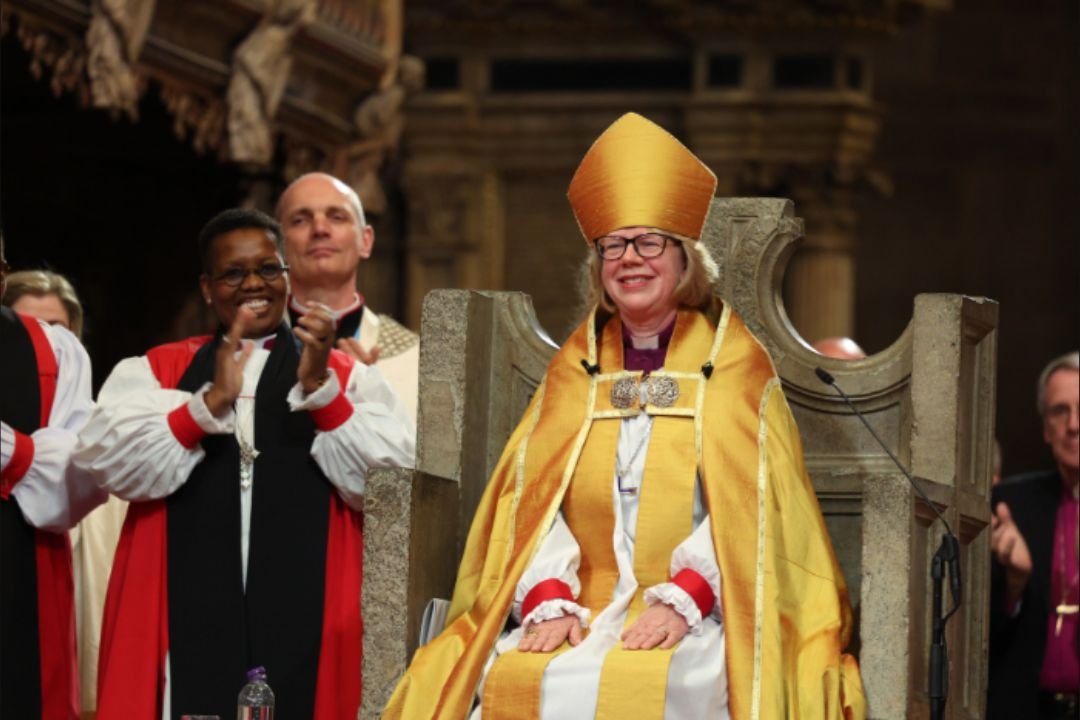
Dame Sarah Mullally Installed as First Female Archbishop of Canterbury in Over 1,400 Years
In a ceremony rich with ancient ritual and profound symbolism, Dame Sarah Mullally was formally installed today as the 106th Archbishop of Canterbury at Canterbury Cathedral, becoming the first woman to hold the historic office in its more than 1,400-year history.
The installation took place on the Feast of the Annunciation, attended by approximately 2,000 guests, including the Prince and Princess of Wales (representing King Charles III as Supreme Governor of the Church of England), Prime Minister Keir Starmer, and leaders from various faith traditions. Mullally, 63, processed through the cathedral and was first installed in the Bishop’s Chair in the choir before taking her seat in the 13th-century Chair of St. Augustine – the traditional seat of the Archbishop.
The service blended centuries-old Anglican liturgy with contemporary elements, including oaths, the presentation of the pastoral staff, and the enthronement itself. In her remarks, Mullally reflected on the personal significance of the moment, noting that her teenage self “could never have imagined” such a future.
A Historic Break with Tradition
The Archbishopric of Canterbury traces its roots to St Augustine of Canterbury, who arrived in Kent in 597 AD to evangelise the Anglo-Saxons. For over 1,400 years, every holder of the office – from Augustine through figures like Thomas Becket (martyred in the cathedral in 1170) to modern predecessors such as Justin Welby – has been male.
Women’s ordination in the Church of England came relatively late: women became priests in 1994 and bishops only in 2014. Mullally was among the first wave of female bishops, consecrated in 2015 as Suffragan Bishop of Crediton in the Diocese of Exeter, and later becoming the first female Bishop of London in 2018. Her background is distinctive for the role – she trained and worked as a nurse and midwife, rising to become Chief Nursing Officer for England before ordination, bringing deep experience in healthcare, public service, and pastoral care.
Commentators described the installation as a moment that would have seemed nearly unimaginable even 50 years ago. The ceremony’s pageantry framed this breakthrough as an organic evolution of the Church rather than a rupture with its past.
Royal and Constitutional Significance
The presence of the Prince and Princess of Wales underscored the enduring constitutional link between the monarchy and the established Church. Last month, King Charles received Mullally at Buckingham Palace for her homage as Supreme Governor. The Royal Family’s statement highlighted the Archbishop’s multifaceted role as constitutional adviser, participant in royal ceremonies, and collaborator with interfaith leaders on shared community goals.
This relationship dates back to the English Reformation under Henry VIII. Today, the monarch remains formally Supreme Governor, while the Archbishop retains a seat in the House of Lords as one of the Lords Spiritual.
Challenges Ahead
Mullally assumes leadership at a challenging time for the Church of England and the wider Anglican Communion. The Church continues to experience numerical decline, with average weekly attendance still significantly below pre-COVID levels and an ageing congregation. Internationally, her appointment has strained relations with more conservative provinces, particularly in Africa and Asia under the GAFCON network, which has criticised progressive shifts on issues including same-sex blessings and women’s ordination.
Domestically, Mullally’s past comments on abortion have drawn criticism from some conservatives. She has described herself as leaning “pro-choice rather than pro-life” in earlier writings while affirming the Church’s principled opposition to abortion except in strictly limited circumstances, and emphasising compassion and support for women in crisis pregnancies.
She also inherits ongoing debates over safeguarding, liturgy, mission strategy, and the Church’s role in an increasingly secular and pluralistic society.
In her installation address, Mullally signalled a ministry focused on unity, compassion, and service amid division. The global Anglican Communion – approximately 85 million members worldwide – will watch closely to see whether she can bridge divides, revive flagging congregations, and maintain the institution’s moral and spiritual authority.
