
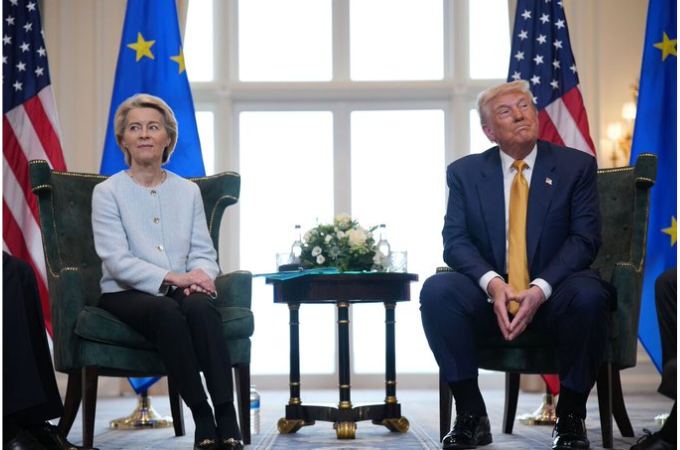
EU-US Trade Pact Stalls as Trump Slaps Tariffs on Greenland Critics
A major EU-US trade agreement has been frozen after US President Donald Trump imposed new tariffs on eight European countries opposing American efforts to acquire Greenland from Denmark.
The deal, signed last July by Trump and European Commission President Ursula von der Leyen, would have capped US tariffs on EU goods at 15 percent while eliminating duties on American exports to the bloc. But European Parliament leaders confirmed ratification is now impossible amid escalating tensions.
Manfred Weber, president of the European People’s Party (EPP), said the Greenland dispute had derailed approval. “The EPP supports the EU-US trade deal in principle, but Donald Trump’s threats regarding Greenland mean approval cannot happen at this stage,” Weber posted on X.
Trump announced the tariffs on January 17, targeting Denmark, Norway, Sweden, France, Germany, the United Kingdom, the Netherlands, and Finland with a 10 percent levy on all imports, rising to 25 percent from June 1. He said the measures would remain “until such time as a Deal is reached for the Complete and Total purchase of Greenland,” citing the island’s strategic Arctic position and risks from Russia and China.
The tariffs follow European reconnaissance and training deployments to Greenland at Denmark’s invitation, which Trump described as provocative. A planned January 26 European Parliament vote on lifting tariffs for US industrial goods has been delayed, with confirmation of the freeze expected next week.
Lawmakers from the S&D, Renew, and Greens groups had already urged a pause; now the EPP has joined them. Karin Karlsboro, Renew’s trade coordinator, said there is no majority to proceed and called for activation of the Anti-Coercion Instrument, which allows restrictions on investment, procurement, and intellectual property against coercive trade practices. Bernd Lange, German S&D chair of the trade committee, demanded an immediate Commission investigation, warning that trade was being weaponised for political ends.
Von der Leyen and European Council President António Costa expressed firm support for Denmark and Greenland, warning of a dangerous escalation in transatlantic relations. Renew leader Valérie Hayer described Trump’s moves as unacceptable, urging the EU to shift from reliance to deterrence.
Protests continued in Copenhagen and Nuuk over the weekend, with demonstrators waving Greenlandic flags and rejecting any sale of the territory. Denmark and Greenland reiterated that the island is not for sale and stressed the right to self-determination.
The standoff highlights deepening strains within NATO and transatlantic cooperation amid heightened Arctic competition.
